Baking Soda for Dark Spots and Wrinkles: What You Should Know
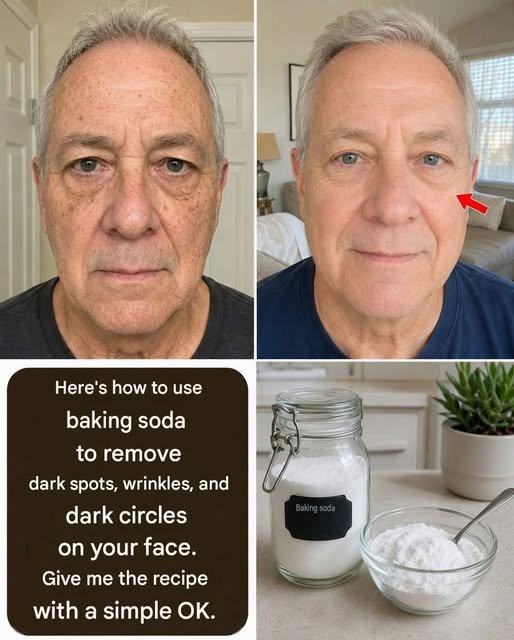
Baking soda is a common household ingredient, and viral beauty posts sometimes promote it as a simple way to remove dark spots, wrinkles, and dark circles. The image accompanying this topic presents dramatic before-and-after results and suggests that baking soda can create noticeably younger-looking skin.
While baking soda can gently alter the skin’s surface chemistry, there is no good evidence that applying it to the face removes wrinkles, dark circles, or pigmentation permanently. In fact, using it incorrectly may irritate the skin and make some pigmentation problems worse.
🧂 Why Do People Use Baking Soda on Skin?
Baking soda, or sodium bicarbonate, is alkaline and mildly abrasive. Because of these properties, it may temporarily remove some surface oils and dead skin cells.
That temporary smoothing effect can make skin feel softer, but it is very different from actually treating wrinkles or pigmentation.
✨ Can Baking Soda Remove Wrinkles?
No.
Wrinkles develop because of changes in collagen, elastin, skin structure, genetics, aging, and especially cumulative sun exposure.
Baking soda cannot rebuild collagen or reverse these structural changes.
If the skin looks temporarily smoother after exfoliation, that effect shouldn’t be confused with wrinkle removal.
🌙 What About Dark Circles?
Dark circles have many possible causes, including genetics, thin skin, pigmentation, allergies, lack of sleep, and changes associated with aging.
Baking soda isn’t an established treatment for these causes.
Applying an irritating substance around the eyes can actually lead to redness, dryness, or inflammation.
🟤 Can It Remove Dark Spots?
Dark spots can result from sun exposure, acne, inflammation, hormonal changes, or other skin conditions.
Rather than using baking soda, evidence-based options may include ingredients such as niacinamide, vitamin C, azelaic acid, or retinoids, depending on the type of pigmentation and your skin’s tolerance.
Most importantly, daily sunscreen helps prevent existing pigmentation from becoming darker.
⚠️ Why You Should Be Careful
The skin has a naturally acidic environment known as the acid mantle. Baking soda is considerably more alkaline.
Frequent or concentrated application may cause:
Dryness
Burning or stinging
Redness
Irritation
Disruption of the skin barrier
Increased sensitivity
Scrubbing baking soda aggressively against the skin can add further irritation.
🌿 A Better Simple Skincare Routine
If your goal is smoother, brighter-looking skin, a simple routine is usually more useful than a harsh DIY treatment.
Morning
Gentle cleanser
Moisturizer
Broad-spectrum SPF 30+ sunscreen
Evening
Gentle cleanser
Moisturizer
An appropriate evidence-based active ingredient, if tolerated
Introduce new skincare products gradually rather than using several strong ingredients at once.
💡 If You Still Want to Try a DIY Treatment
For facial skin, especially sensitive or mature skin, baking soda is not my first recommendation.
A gentle, fragrance-free moisturizer is a much safer choice for improving dryness and temporarily making fine lines appear less noticeable.
If you have persistent dark spots, unusual pigmentation, or a changing skin lesion, a dermatologist can determine the cause and recommend an appropriate treatment.
Final Thoughts
The before-and-after image makes baking soda look like a powerful anti-aging treatment, but those results shouldn’t be taken as proof that baking soda removes wrinkles or dark spots.
Baking soda is useful in the kitchen, but facial skin generally benefits more from gentle cleansing, moisturization, sun protection, and proven skincare ingredients.
For healthier-looking skin, consistency matters far more than a viral “miracle” recipe. ✨