Baking Soda for Dark Spots and Wrinkles: Does This Viral Skincare Trick Really Work?
And Can It Remove Dark Circles?
Dark circles aren’t caused by one single problem.
They can be associated with pigmentation, visible blood vessels, shadows created by facial structure, thin skin, genetics, and age-related changes.
Because the skin around the eyes is delicate, applying an untested homemade baking-soda mixture there is especially questionable.
Baking soda should not be treated as a proven remedy for under-eye dark circles.
Why the “Before and After” Photo Can Be Misleading
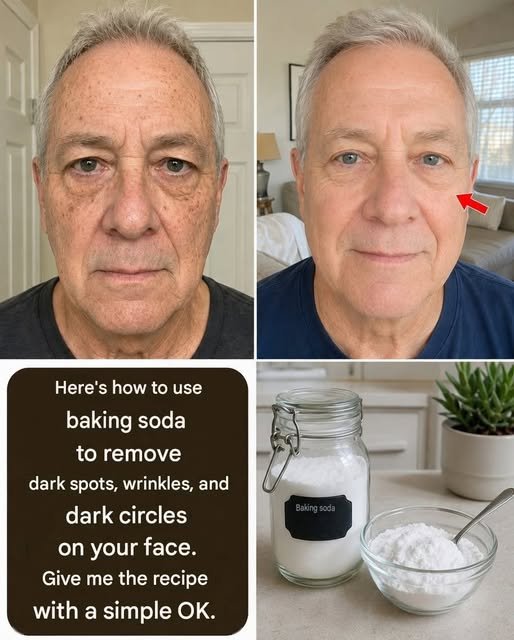
The photograph in the viral post makes the difference appear dramatic, but photographs aren’t controlled scientific evidence.
Changes in:
Lighting
Camera angle
Facial expression
Makeup
Image processing
Skin hydration
Exposure and contrast
can significantly change how facial skin looks.
A before-and-after image therefore cannot establish that baking soda caused the apparent improvement.
The Biggest Problem With DIY Baking Soda Scrubs
Baking soda can be abrasive when used as a scrub, and its alkalinity can disturb the skin’s natural environment.
Dermatologists warn that aggressive exfoliation can irritate the skin. For people prone to pigmentation—particularly those with darker skin tones—irritation may increase the risk of developing additional dark spots. (Académie Américaine de Dermatologie)
The American Academy of Dermatology also advises stopping skincare products that sting or burn because irritation can make signs of aging more noticeable. (Académie Américaine de Dermatologie)
What Actually Helps With Dark Spots?
The first step is determining why the spots appeared.
For common hyperpigmentation, dermatologists may recommend ingredients such as:
Daily sun protection is also extremely important. The AAD recommends broad-spectrum sunscreen with SPF 30 or higher as part of protecting skin from premature aging and helping prevent dark spots from becoming more noticeable. (Académie Américaine de Dermatologie)
A Simple, Safer Skincare Routine
Instead of experimenting with baking soda, a basic routine can be much more useful.
Morning
1. Gentle cleanser Avoid aggressive scrubbing.
2. Moisturizer Choose one suitable for your skin type.
3. Broad-spectrum SPF 30+ sunscreen This is one of the most important steps for protecting against UV-related aging and pigmentation.
Evening
1. Gentle cleanser
2. One targeted treatment Choose an evidence-based ingredient appropriate for your particular concern.
3. Moisturizer
The AAD recommends introducing anti-aging products carefully rather than using multiple strong products simultaneously, because irritation can make skin concerns more noticeable. (Académie Américaine de Dermatologie)
What If You Still Want to Try a New Product?
Don’t immediately apply an unfamiliar product all over your face.
The AAD recommends testing skincare products on a small area first and watching for redness, itching, or other reactions before using them more broadly. (Académie Américaine de Dermatologie)
And if a product burns or stings, that’s not necessarily a sign that it’s “working.” Irritation can damage the skin barrier and potentially worsen pigmentation. (Académie Américaine de Dermatologie)
The Bottom Line
The viral claim that baking soda can remove dark spots, wrinkles, and dark circles is much stronger than the available evidence.
Baking soda may have various household uses, but there is no good evidence that applying it directly to the face will produce the dramatic anti-aging transformation shown in viral before-and-after images.
For healthier-looking skin, the evidence-based basics remain much simpler:
Gentle skincare + moisturizer + daily sun protection + targeted ingredients when appropriate.
And if persistent dark spots, rapidly changing pigmentation, or unusual skin changes concern you, getting the cause evaluated by a dermatologist is far more useful than repeatedly trying homemade remedies. (Académie Américaine de Dermatologie)