Why Do Visual Counting Puzzles Fool Us?
These puzzles demonstrate a simple feature of human visual attention.
Our eyes don’t process every part of a complicated image with equal attention. We tend to notice objects that are:
- Larger
- More central
- More visually prominent
- Less obstructed
- Surrounded by empty space
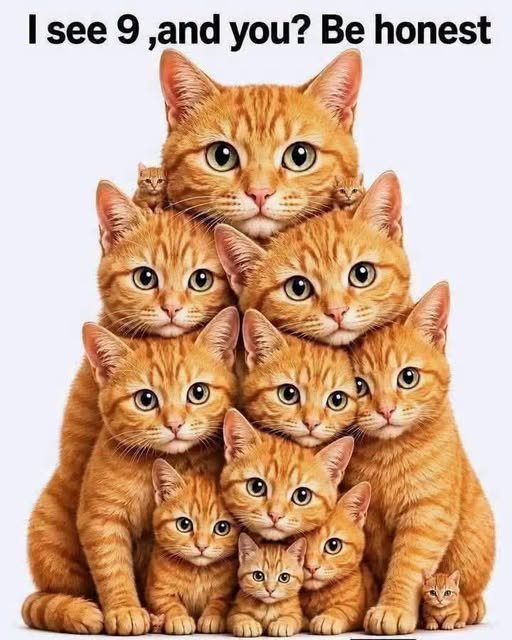
A tiny kitten sitting beside several larger cats doesn’t attract the same amount of attention as the huge cat in the center.
That’s exactly what makes the puzzle work.
A Fun Challenge for Friends and Family
This is an easy puzzle to turn into a conversation.
Show the image to someone without telling them the answer and ask:
“How many cats do you see?”
Give them a few seconds to count, then ask them to check the corners again.
You may get very different answers—even from people looking at exactly the same picture.
Can You Find Them All Without Counting Twice?
For an extra challenge, try counting the cats without pointing at them or moving your finger across the image.
Start at the top and work systematically downward.
Once you reach the bottom, check the edges one final time.
This method makes it much easier to avoid accidentally counting the same face twice.
Final Thoughts
This adorable cat puzzle is a perfect example of how the smallest detail can make a simple-looking challenge surprisingly tricky.
The large cats immediately grab your attention, while the tiny kitten hiding near the bottom-right is much easier to overlook.
So, be honest:
Did you see all 10 cats on your first try? 🐱🐱🐱
Related Posts: