The Viral “Youth-Returning” Gel: Can It Really Make Wrinkles Disappear?
What Happens to Skin as We Age?
As we get older, the skin gradually changes.
It loses some of its collagen and elastin, becomes thinner and less resilient, and develops lines and wrinkles. Long-term ultraviolet exposure also contributes significantly to premature skin aging, including wrinkles, age spots, and changes in skin texture. (Académie Américaine de Dermatologie)
A topical homemade mixture can’t simply reverse all of those processes overnight.
Be Careful With Homemade Ingredients
One of the biggest problems with viral skincare recipes is that the exact ingredients and concentrations are often unclear.
Something that sounds gentle—such as a gel made from a plant, starch, food ingredient, or household product—can still cause irritation or an allergic reaction when applied to the face.
The American Academy of Dermatology recommends testing new skincare products on small areas before applying them more broadly because even skincare ingredients can cause redness, itching, or swelling. (Académie Américaine de Dermatologie)
And if a homemade mixture burns or stings, that’s not evidence that it’s “working.”
What About Baking Soda?
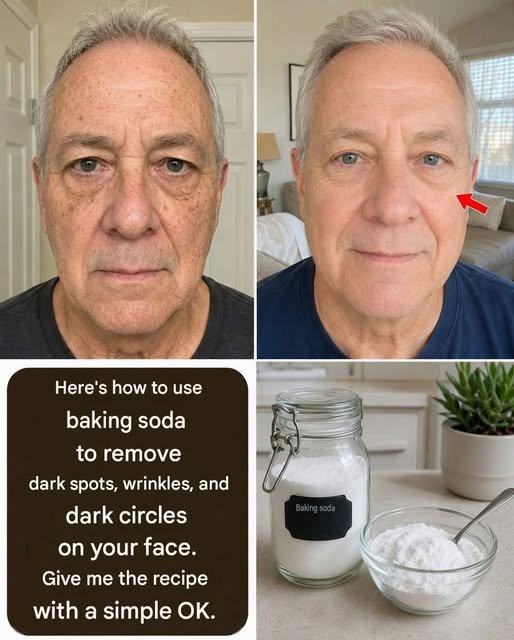
If the recipe associated with this image contains baking soda, extra caution is warranted.
Baking soda is alkaline, while healthy skin normally has a mildly acidic environment. Research has found that repeated exposure to alkaline products can interfere with the skin barrier. (PubMed)
The American Academy of Dermatology also warns that baking soda-containing abrasive ingredients can irritate skin. (Académie Américaine de Dermatologie)
That makes baking soda a poor choice for a DIY anti-aging treatment, particularly for sensitive or already-irritated skin.
What Actually Has Evidence Behind It?
If the goal is healthier, smoother-looking skin, dermatologists recommend approaches with considerably more evidence.
1. Daily Sun Protection
UV exposure is one of the major contributors to premature skin aging.
Retinoids are among the better-studied topical ingredients for certain signs of aging. They can improve skin texture and help reduce the appearance of fine lines and wrinkles over time. (Académie Américaine de Dermatologie)
However, retinoids can cause irritation and aren’t appropriate for everyone, so they should be introduced carefully.
4. Targeted Treatment
If the main concern is dark spots, wrinkles, or uneven texture, choosing an ingredient specifically formulated for that problem is generally more sensible than using an unknown kitchen recipe. The AAD notes that ingredients such as vitamin C and retinoids can be useful for certain pigmentation and aging concerns. (Académie Américaine de Dermatologie)
Why Viral Before-and-After Photos Can Be Misleading
The image shows a dramatic transformation, but photographs can change substantially because of:
Lighting
Camera angle
Facial expression
Makeup
Skin hydration
Image editing
Different photographs taken at different times
A before-and-after photograph therefore cannot prove that a particular homemade mixture produced the result.
A Simple Rule for DIY Skincare
Before trying a viral recipe, ask three questions:
What exactly is in it?
Is there evidence that those ingredients work for the claimed purpose?
Could they irritate the skin?
If those questions can’t be answered confidently, it’s better not to experiment directly on the face.
Final Thoughts
The translucent gel in the photograph may look impressive, and properly formulated moisturizing products really can make skin look temporarily smoother and more hydrated.
But claims that a homemade recipe will make wrinkles disappear, tighten significantly sagging skin, or literally bring youth back to the face aren’t supported by good evidence.
For long-term skin health, the less glamorous approach is often the more reliable one:
Moisturize, protect your skin from the sun, use evidence-based ingredients when appropriate, and avoid harsh DIY treatments.
A viral recipe may promise a dramatic transformation overnight—but healthy skin care is usually about consistent habits and realistic expectations, not a miracle mixture.