What Are These Strange Glass Tubes? The Simple Tool Hidden in Plain Sight
Why Are the Vials Shaped Like This?
The shape is carefully engineered rather than decorative.
A level vial typically has a curved internal surface. This allows the air bubble to move predictably when the vial is tilted.
The curvature also influences the sensitivity of the level. A larger radius of curvature can allow a small change in angle to produce a measurable movement of the bubble. (studylib.net)
That’s why these seemingly simple glass tubes can provide surprisingly precise information.
How Does a Spirit Level Work?
Imagine placing a spirit level on a table.
If the surface is perfectly horizontal, the bubble settles near the center between the reference markings.
Tilt the level slightly, and the bubble moves toward one side.
The farther the surface moves away from level, the farther the bubble travels.
This gives the user an immediate visual indication without requiring electronics, batteries, or complicated machinery.
Why Are There Different Vials?
A single leveling instrument can contain more than one vial.
For example, a traditional spirit level may have separate vials for checking different orientations, such as horizontal and vertical alignment.
Specialized instruments can also use different vial designs depending on the degree of precision required.
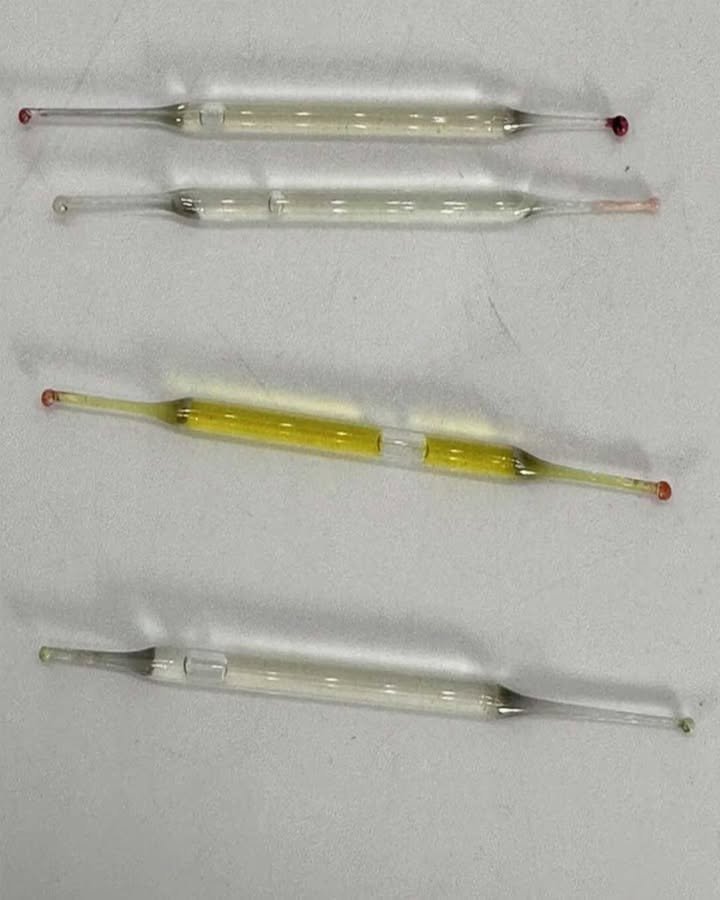
The photograph shows several individual glass vials that could be used as components in different leveling instruments.
How Are These Tiny Glass Components Made?
Manufacturing a precision vial requires much more control than simply bending a piece of glass.
The glass needs to have the appropriate shape and internal geometry, and the liquid volume and air bubble must be carefully controlled.
For precision instruments, even small imperfections can affect the movement of the bubble and therefore the accuracy of the measurement.
The vial is ultimately sealed so that the liquid and air bubble remain stable during normal use.
Why Are They Sometimes Called “Spirit” Levels?
The term spirit level comes from the historical use of alcohol-based liquids in these instruments. The word “spirit” was traditionally used for alcohol, and the name remained even as different fluids came into use. (studylib.net)
Today, the term is still commonly used for the complete leveling tool.
Where Are Level Vials Used?
These small components are surprisingly versatile.
They can be found in tools used by:
Carpenters — checking whether shelves, frames, and structures are horizontal.
Builders — aligning walls, surfaces, and construction components.
Engineers — checking machinery and precision surfaces.
Installers — positioning equipment correctly.
Manufacturers — incorporating leveling indicators into specialized tools.
Precision spirit levels can also be used for checking straightness, flatness, and machine alignment. (studylib.net)
Why Does the Bubble Move?
The explanation is simple physics.
The liquid inside the vial is heavier than the air bubble. Under gravity, the liquid settles toward the lower side while the bubble rises toward the highest point.
Because the vial is curved, the bubble naturally travels toward the center when the instrument is correctly positioned.
That tiny bubble essentially acts as a visual indicator of gravity.
A Remarkably Simple Invention
What makes these glass vials fascinating is their simplicity.
There are no batteries, screens, motors, or electronic sensors involved. A carefully shaped glass tube, a small amount of liquid, and a precisely controlled air bubble are enough to provide a useful measurement.
The technology is simple—but manufacturing it accurately is what makes the tool reliable.
Frequently Asked Questions
Are these tiny thermometers?
They may look similar to miniature thermometers, but the objects shown are consistent with level vials, not ordinary temperature thermometers.
What is the bubble for?
The bubble indicates the highest point inside the vial. Its position relative to reference markings tells the user whether the instrument is level.
Why is some of the liquid yellow?
Color can make the liquid and bubble easier to see. The exact color and fluid depend on the particular vial and manufacturer.
Can a level vial work without markings?
Yes. The vial itself can function as the sensing element, although markings are normally provided so the user can determine when the bubble is correctly centered.
Are these used only in construction?
No. Level vials can be incorporated into many tools and precision instruments where determining orientation or alignment is important.
Final Thoughts
Those strange glass tubes in the photograph are a great example of simple physics turned into an everyday measuring device.
Inside each vial, a tiny air bubble and a carefully selected liquid work together with gravity. When installed into a spirit level or another instrument, that little bubble can tell you whether a surface is properly aligned.
What looks like nothing more than a small glass tube is actually a precisely designed measuring component—and one that has remained useful for generations.