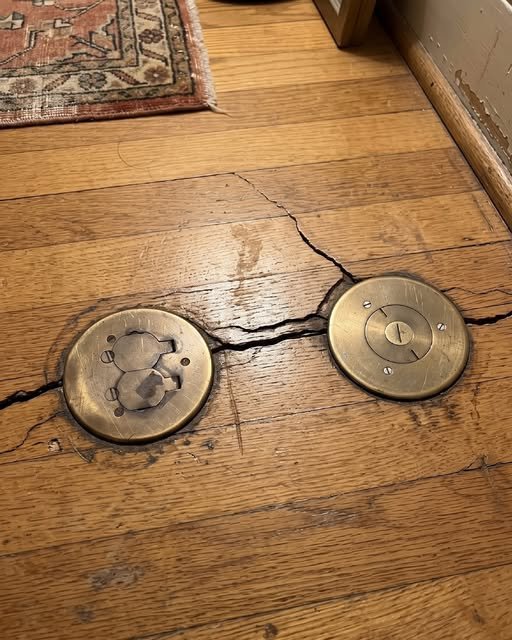
Why Are These Two Brass Discs Embedded in an Old Wooden Floor?
Why Are There Two of Them?
The paired arrangement is one of the most intriguing details.
Two pieces of hardware positioned some distance apart can indicate that they once worked together. Depending on the original construction, they could have been connected to:
A removable floor panel
A concealed hatch
An old locking mechanism
A hinged or secured access opening
Older building or utility hardware
The exact purpose cannot be established from the photograph alone, particularly because part of the original structure may have been removed or altered over the years.
The Crack Is Probably a Separate Story
The large crack running through the floor makes the image look almost mysterious, but it doesn’t necessarily mean the brass fittings caused the damage.
Wood flooring naturally changes dimension as temperature and humidity change. Over many years, movement, drying, structural settling, previous repairs, and heavy use can produce gaps or cracks.
In this photograph, the boards around the fittings also show considerable age and wear.
If the crack is still expanding, however, that’s worth investigating rather than simply filling it with wood putty.
Why Brass Was Used
Brass was a practical material for older household hardware.
It is relatively corrosion-resistant, durable, easy to machine, and visually attractive. Brass was commonly used for architectural hardware such as door fittings, hinges, locks, handles, and other components.
That’s why finding old brass hardware in an older building isn’t necessarily surprising.
What is more unusual here is the size, shape, and placement of the fittings.
Could This Have Been a Safe?
A hidden floor safe is another possibility that people might immediately think of when seeing unusual circular hardware embedded in a floor.
However, the photograph alone isn’t enough to identify these as safe components.
A genuine floor safe would normally have additional structural evidence around it, such as a recognizable door, hinges, locking mechanism, reinforced opening, or a surrounding frame.
The safest conclusion is therefore that the brass pieces are old functional floor hardware, possibly associated with an access opening or concealed panel, rather than confidently labeling them as a safe.
What Should You Do If You Find Something Similar?
If you discover old fittings like these in your own home, don’t immediately pry them out.
First, photograph the hardware from several angles and examine the surrounding floor carefully.
Look for:
Straight seams forming a rectangular or square outline
Hinges
Additional screws or fasteners
A removable section of flooring
Evidence of an opening underneath
Old pipes, wiring, or ventilation nearby
Matching hardware elsewhere in the house
If the property is old, architectural salvage specialists, restoration professionals, or experienced carpenters may also be able to recognize the hardware from its construction and style.
A Small Detail That Can Reveal a Home’s History
Old houses often contain clues that are easy to overlook.
A filled-in doorway, unusual piece of molding, bricked-up fireplace, old electrical fitting, or piece of brass hardware can tell us that a building has been modified many times throughout its life.
These two fittings may be nothing more than remnants of an obsolete floor mechanism—but they could also mark the location of an old access point that was later covered or altered.
The most interesting part is that the floor itself may be preserving evidence of something that used to be there.
Final Thoughts
The two brass discs in this photograph appear to be old, purpose-built floor fittings, and their construction suggests they once served a practical function. An access hatch, removable panel, or concealed fastening system are plausible explanations, but the image isn’t sufficient to determine the exact original purpose.
And that’s what makes old-house discoveries so fascinating.
Sometimes a strange object isn’t valuable because of what it is—it’s valuable because it provides a tiny clue about what the house looked like and how it was used decades ago.