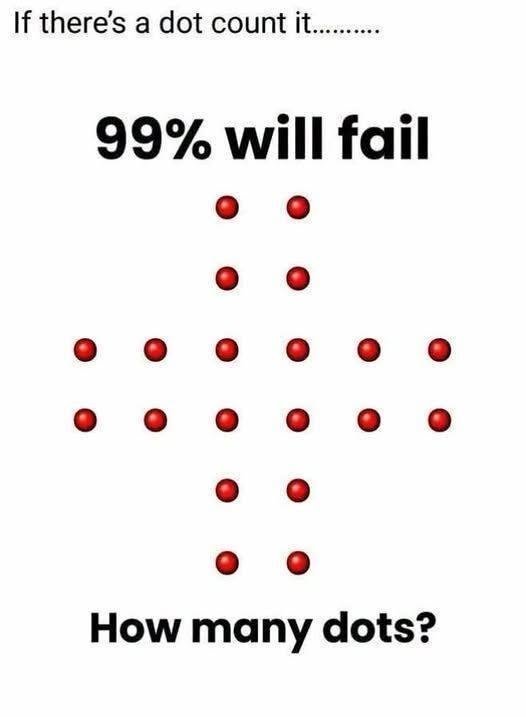
“99% Will Fail”: Can You Count the Exact Number of Dots in This Picture?
Perhaps the most frustrating outcome is getting a number that is extremely close.
You might count 97 when the correct answer is 98.
Or perhaps you get 104 when the actual number is 103.
Being close can feel like success, but an exact-count puzzle has only one correct total.
This is what makes these puzzles particularly effective for social media: people naturally want to check whether their answer matches everyone else’s.
Don’t Trust the “99% Will Fail” Claim Too Literally
Titles such as “99% Will Fail” or “Only 1% Can Get It Right” are common in viral puzzles.
Unless the creator provides a properly conducted survey or experiment, however, there is no reason to assume that exactly 99% of people will fail.
The phrase is usually intended to create curiosity and encourage people to attempt the challenge.
The real test is much simpler:
Can you count every dot without skipping or repeating any?
The Psychology Behind Visual Challenges
Visual puzzles are entertaining partly because they expose the difference between seeing something and carefully observing it.
You can look directly at an image and still miss important details.
This happens because perception isn’t simply a camera-like recording of everything in front of us. Attention determines which details receive more processing.
When an image contains many repetitive elements, maintaining attention on each individual object requires deliberate effort.
That’s why taking your time can dramatically improve accuracy.
A Simple Challenge for Yourself
Before looking for the answer in the comments, try this method:
Cover the surrounding distractions.
Divide the image into equal sections.
Count each section separately.
Write down every subtotal.
Add the subtotals together.
Repeat the count from a different direction.
Compare the two totals.
If both counts agree, you may have solved the puzzle correctly.
And if they don’t?
That’s a sign that one of the sections deserves another look.
Why These Puzzles Are So Addictive
The appeal isn’t really about dots.
It’s about the feeling of solving something that initially appears obvious.
A simple picture suddenly becomes a test of concentration. The moment you discover that your first answer was wrong, you want to try again.
That combination of simplicity, uncertainty, and curiosity makes visual counting puzzles perfect for sharing online.
Final Thoughts
Counting dots sounds easy until you’re asked to find the exact number.
The challenge reveals how easily our attention can be affected by repetition, grouping, visual clutter, and simple counting errors. Rather than relying on a quick estimate, the most reliable approach is to divide the image into sections, count systematically, and verify the result.
So before you scroll to the answer, take another look.
How many dots can you count—and are you absolutely certain?