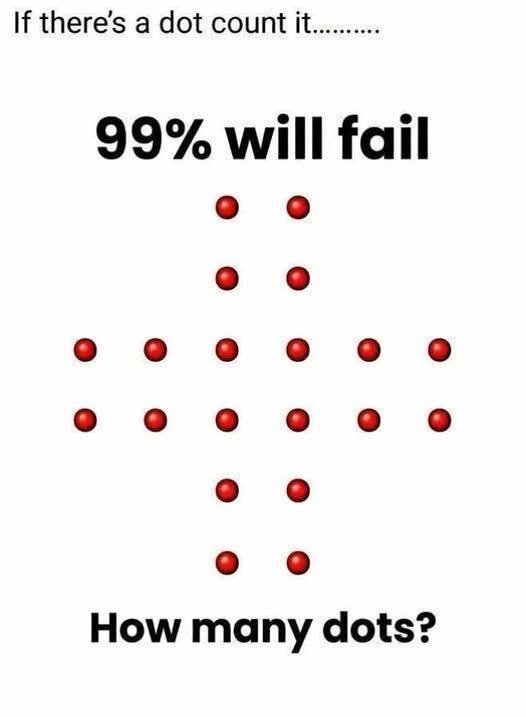
“99% Will Fail”: Can You Count the Exact Number of Dots in This Picture?
At first glance, counting dots seems like one of the easiest challenges imaginable. You simply look at the picture and count them, right?
Not always.
Visual puzzles involving dozens of dots are designed to make a simple task surprisingly difficult. Repeated shapes, uneven spacing, visual clutter, and the tendency of our eyes to jump from one area to another can make it surprisingly easy to lose track.
That is why the challenge “Can You Count the Exact Number of Dots?” has become such an engaging type of internet puzzle.
But can you really get the exact answer?
Why Counting Dots Is Harder Than It Looks
Our eyes are excellent at recognizing patterns, but they are not perfect at performing repetitive counting tasks.
When many similar objects appear close together, the brain tends to process them as groups rather than as individual objects. Instead of consciously registering every single dot, we may see clusters of five, ten, or twenty and estimate the total.
That can produce a surprisingly confident—but incorrect—answer.
The problem becomes even harder when dots are arranged irregularly.
Your eyes may move naturally from left to right, then jump to another section. When you return to the previous area, you may accidentally count the same dots twice or skip a few entirely.
The Biggest Mistake: Counting Too Quickly
One of the most common strategies is also one of the least reliable: simply looking at the entire picture and estimating.
A viewer might think:
“There are probably around 100 dots.”
But an estimate isn’t the same as an exact count.
If the challenge asks for the exact number, even being off by one means the answer is incorrect.
This is why slowing down is often more useful than trying to count faster.
A Better Way to Count
If you want to solve a dot-counting puzzle accurately, use a systematic method.
1. Divide the Picture Into Sections
Imagine the image is divided into several horizontal or vertical zones.
Instead of counting the entire picture at once, count one section at a time.
For example:
Top section
Upper-middle section
Center section
Lower-middle section
Bottom section
Record each subtotal before moving on.
2. Count in Small Groups
Rather than counting individual dots continuously from one to the end, group them into manageable sets.
Groups of five or ten are easier to keep track of than a long uninterrupted sequence.
3. Use a Consistent Direction
Choose one direction and stick with it.
You could count from left to right, moving downward row by row. Alternatively, count from top to bottom.
The important part is consistency.
4. Double-Check the Total
Once you’ve reached your final number, don’t immediately assume you’re finished.
Count the picture again using a different method.
If your first count was performed from left to right, try dividing the image into sections for your second count. If both totals match, your confidence increases considerably.
Why Your Brain Can Be Tricked
Dot-counting puzzles demonstrate several basic principles of visual perception.
One of them is grouping.
When objects look similar and are positioned close together, our brains naturally perceive them as belonging to a group. This is useful in everyday life because we don’t normally need to consciously count every object around us.
Imagine walking through a field containing hundreds of flowers. You don’t count every flower individually. Your brain quickly recognizes the overall scene.
A puzzle reverses that advantage.
It asks you to ignore the overall pattern and focus on every individual element.