A Snake in the House? What This Unexpected Visitor May Be Trying to Tell You
Should You Be Worried?
The most important thing is not to handle an unidentified snake.
Many snake species are harmless and actually provide useful natural pest control by eating rodents and insects. But because species vary considerably from one region to another, it is safer to treat an unknown snake cautiously until it has been identified. (Extension Missouri)
If the snake appears potentially venomous, is behaving defensively, or you simply aren’t comfortable removing it, contacting a qualified wildlife professional is the safest option.
What Should You Do If You Find One?
First, keep people and pets away from the area.
If possible, close the snake into one room so it cannot disappear into another part of the house. A rolled towel placed along the bottom of a closed door can help prevent it from moving underneath. (Extension Missouri)
If the species is known to be harmless and you are comfortable doing so, wildlife guidance describes gently directing a snake into a deep container using a broom or similar long-handled object and then releasing it outdoors where appropriate. (Extension Missouri)
Never attempt to grab an unfamiliar snake by hand.
How Did It Get Inside?
After the snake has been safely removed, look for possible entry points.
Pay particular attention to:
Gaps around exterior doors
Basement windows
Foundation cracks
Openings around pipes and cables
Garage doors
Dryer or utility vents
Gaps around siding or other exterior structures
Extension specialists recommend sealing appropriate cracks and openings to reduce the chance of snakes and other wildlife entering the building. (Publications et Ressources Éducatives)
Don’t Forget About Rodents
If snakes are repeatedly appearing around a home, investigate whether mice or other small animals are present.
Snakes can follow prey into buildings, so reducing available food sources can make the property less attractive to them. Missouri Extension, for example, specifically recommends investigating hidden rodent problems when snakes repeatedly appear indoors. (Extension Missouri)
Keeping vegetation trimmed, reducing piles of wood or debris near the house, and removing other places where rodents and snakes can hide can also help. (Extension Missouri)
Are Snakes Actually Helpful?
Although many people understandably don’t want one crawling across their living room, snakes play an important role in ecosystems.
Many species consume rodents, insects, and other animals that people may consider pests. This means that a snake outdoors can sometimes be a useful part of the natural environment. (Extension Missouri)
The goal isn’t necessarily to eliminate every snake from the surrounding area—it’s to prevent unwanted encounters inside the home.
Final Thoughts
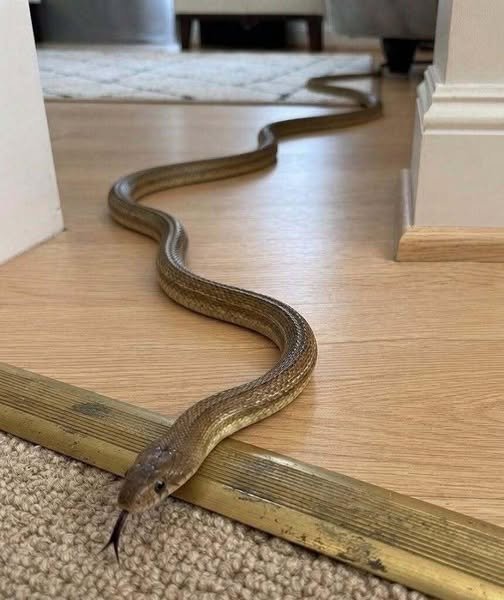
Seeing a snake glide across your floor is certainly an unforgettable experience, but there is usually a logical explanation.
It may have entered while searching for food, shelter, cooler or warmer conditions, or simply through an unnoticed opening.
The safest approach is simple: don’t panic, don’t try to handle an unidentified snake, keep children and pets away, and arrange safe removal if necessary. Then investigate how it got inside and address any gaps, clutter, or rodent activity that could attract another visitor.
Sometimes the snake isn’t looking for trouble at all—it may simply have taken a wrong turn.