Are Your Nails Always Splitting or Breaking? What Your Nails May Be Telling You
Your Manicure Could Be Contributing
Repeated artificial-nail treatments can weaken natural nails.
The American Academy of Dermatology explains that preparing nails for acrylic applications often involves filing the natural nail surface, which can make the nails thinner and weaker. Repeated removal and touch-ups can contribute to further damage. (Académie Américaine de Dermatologie)
If your nails became noticeably weaker after frequent gel, acrylic, or other manicure treatments, giving the natural nails a break may help.
Simple Ways to Protect Your Nails
You don’t necessarily need an expensive supplement or complicated treatment.
Keep Nails Reasonably Short
Shorter nails are less likely to catch on clothing and other objects, reducing mechanical stress.
Protect Your Hands
If you wash dishes, clean frequently, or work with chemicals, wear protective gloves. (nhs.uk)
Moisturize Regularly
Applying hand cream to your hands, nails, and surrounding skin can help reduce dryness and keep the area more flexible. (nhs.uk)
Don’t Pick or Peel
If the nail begins separating into layers, don’t pull the loose portion off. That can cause additional trauma.
Be Gentle With Manicures
Avoid aggressive filing and cutting around the nail. If your nails are already thin or damaged, covering them with artificial nails may not solve the underlying problem and can sometimes make the damage worse. (Académie Américaine de Dermatologie)
When Should You Get Your Nails Checked?
Occasional nail splitting isn’t usually a sign of something serious. But persistent or unexplained changes deserve attention.
Consider seeing a healthcare professional or dermatologist if you notice:
Persistent splitting or crumbling
Significant color changes
A nail becoming unusually thick
A nail lifting away from the nail bed
Pain or swelling around the nail
Redness or warmth around the nail
Multiple nails suddenly changing
A new dark streak
Nail changes that don’t improve despite basic care
The AAD recommends professional evaluation for unexplained nail changes, particularly changes in color, texture, or shape. (Académie Américaine de Dermatologie)
The Biggest Takeaway
Your nails can sometimes provide clues about what’s happening in your body—but a nail problem rarely points to one single cause.
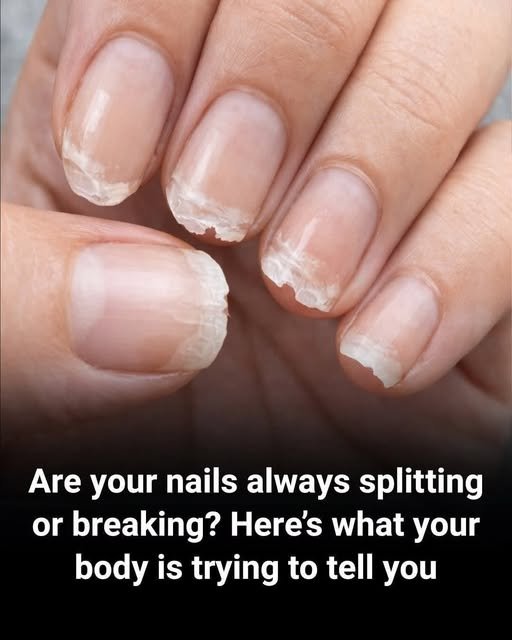
If your nails are repeatedly splitting like those shown in the photograph, start by looking at everyday factors: water exposure, cleaning products, trauma, biting, picking, and manicures.
If the problem continues or other changes appear, a dermatologist or doctor can determine whether an infection, skin condition, medication, or nutritional or medical issue is contributing.
Final Thoughts
Splitting nails are frustrating, but they don’t automatically mean your body is “missing a vitamin.”
Protect your nails, reduce repeated exposure to water and chemicals, moisturize regularly, and pay attention to persistent changes. If the problem continues despite these measures, getting the actual cause identified is much more useful than treating yourself with random supplements or viral nail remedies. (nhs.uk)