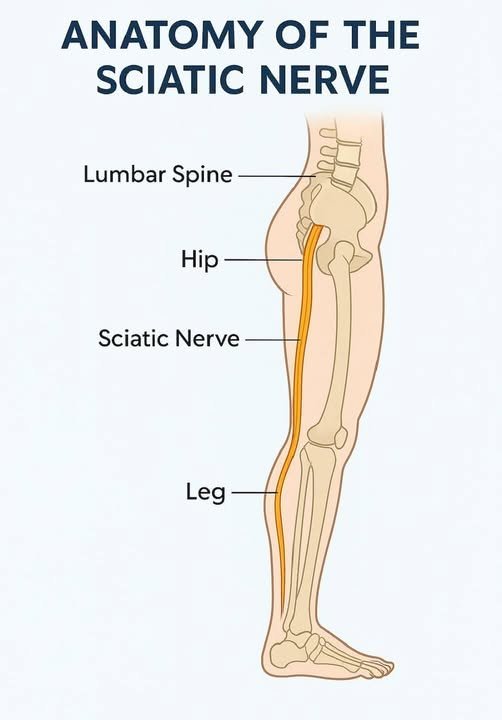
Anatomy of the Sciatic Nerve: Understanding the Body’s Longest Nerve
The human nervous system is an extraordinarily complex communication network, carrying signals between the brain, spinal cord, muscles, skin, and internal organs. Among its many structures, the sciatic nerve is particularly important because of its size, length, and role in movement and sensation in the lower limb.
Often described as the body’s longest and largest nerve, the sciatic nerve is actually a bundle of nerve fibers rather than a single simple cable. It begins in the lower back, travels through the pelvis and buttock, and continues down the leg.
Understanding its anatomy helps explain why irritation or compression of this nerve can cause symptoms that extend well beyond the lower back.
What Is the Sciatic Nerve?
The sciatic nerve is the major nerve supplying much of the lower limb.
It is formed by nerve roots that emerge from the lower portion of the spinal cord. These roots primarily come from the L4 through S3 spinal nerve levels.
The nerve carries both:
Motor signals, which help control muscles
Sensory signals, which contribute to sensation in parts of the leg and foot
Because several spinal nerve roots contribute to it, the sciatic nerve contains a large number of nerve fibers.
Where Does the Sciatic Nerve Begin?
The sciatic nerve originates from the lumbosacral plexus, a network of nerves formed by spinal nerve roots in the lower back and pelvis.
The contributing roots are generally:
L4, L5, S1, S2, and S3.
These nerve fibers join together within the pelvis before forming the large sciatic nerve.
This arrangement is important because irritation of an individual spinal nerve root can produce symptoms that resemble sciatic nerve problems even before the nerve has fully formed.
The Sciatic Nerve’s Path Through the Body
After forming within the pelvis, the sciatic nerve travels toward the buttock and posterior thigh.
In most people, it passes beneath the piriformis muscle through an opening called the greater sciatic foramen.
From there, the nerve travels down the back of the thigh.
Its large size makes it one of the most recognizable peripheral nerves in the human body.
Through the Buttock
The sciatic nerve passes deep beneath the gluteal muscles.
This location is clinically important because irritation or compression in the buttock region can sometimes affect the nerve.
The nerve is protected by surrounding muscles and connective tissues, but its location also means that certain injuries or anatomical variations can affect it.
Down the Posterior Thigh
The sciatic nerve continues down the back of the thigh.
Along this route, it provides motor and sensory connections through branches that ultimately contribute to movement and sensation in the lower leg and foot.
The exact branching pattern can vary between individuals.
The Sciatic Nerve’s Two Major Divisions
Although it is commonly described as one nerve, the sciatic nerve contains two major components:
Tibial division
Common fibular (common peroneal) division
These components often remain together through much of the thigh before separating around the knee region, although the exact point of division varies.
Tibial Nerve
The tibial component continues downward and ultimately contributes to the nerves that supply many muscles of the lower leg and foot.
It plays an important role in movements such as:
Plantarflexion of the ankle
Flexion of the toes
Certain movements of the foot
It also contributes to sensation in portions of the lower leg and foot through its branches.
Common Fibular Nerve
The common fibular component travels toward the outside of the knee and then divides into major branches.
These branches are involved in movements such as lifting the foot and extending the toes.
They also contribute to sensation over portions of the lower leg and foot.
What Does the Sciatic Nerve Control?
The sciatic nerve contributes significantly to movement in the lower limb.
Through its branches, it helps control muscles responsible for movements of the knee, ankle, and foot.
It also contributes to sensation in much of the lower leg and foot.
However, it is important to understand that the sciatic nerve does not directly provide sensation to every part of the lower limb. Different peripheral nerves and their branches supply specific anatomical regions.