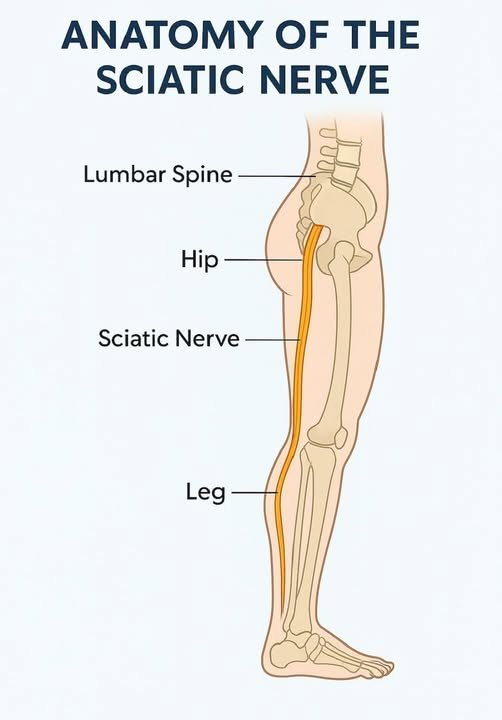
Anatomy of the Sciatic Nerve: Understanding the Body’s Longest Nerve
The sciatic nerve is frequently discussed in relation to sciatica, a term commonly used for pain and other symptoms caused by irritation or compression of the sciatic nerve or, more commonly, its contributing spinal nerve roots.
Sciatica can produce symptoms that extend from the lower back or buttock into the leg.
Possible symptoms include:
Pain
Tingling
Numbness
Burning sensations
Weakness
Symptoms can occur along different parts of the leg depending on which nerve roots or nerve structures are affected.
Common Causes of Sciatic Symptoms
One of the most common causes is a herniated disk in the lower spine.
The spinal disks sit between the vertebrae and help absorb mechanical forces. If part of a disk protrudes or herniates, it can irritate or compress a nearby nerve root.
Other possible causes include:
Spinal narrowing
Bone spurs
Degenerative changes in the spine
Certain injuries
Less commonly, other conditions affecting the nerves
Not every case of lower-back or leg pain is sciatica. Muscles, joints, tendons, and other nerves can produce similar symptoms.
The Piriformis and the Sciatic Nerve
The piriformis muscle is located deep in the buttock.
In most people, the sciatic nerve passes beneath this muscle. Anatomical variations can occur, however, and in some individuals portions of the nerve may pass through or around the piriformis.
This relationship has attracted attention because irritation around the piriformis can sometimes produce symptoms resembling sciatic nerve pain.
Nevertheless, not every buttock or leg symptom should automatically be attributed to the piriformis.
Sciatic Nerve Anatomy Can Vary
Human anatomy is remarkably consistent in many ways, but it is not identical from person to person.
The sciatic nerve can differ in:
Its relationship to the piriformis
The level at which its two major components separate
The precise branching pattern
These anatomical differences are one reason imaging, physical examination, and clinical history can be important when evaluating persistent nerve-related symptoms.
Protecting Nerve Health
There is no single exercise or treatment that guarantees protection of the sciatic nerve.
However, maintaining general musculoskeletal health can support normal movement and reduce some risk factors associated with back problems.
Helpful habits may include:
Regular physical activity
Strengthening the muscles that support the trunk and hips
Maintaining healthy movement patterns
Avoiding prolonged inactivity
Using appropriate lifting techniques
Maintaining a healthy body weight
People with persistent or recurrent symptoms should seek individualized advice from a qualified healthcare professional rather than relying solely on general exercises.
When Sciatic Symptoms Need Medical Attention
Many episodes of back-related leg pain improve with time, but certain symptoms require prompt medical assessment.
Seek urgent medical attention if back or leg symptoms are accompanied by:
New or worsening weakness in the leg
Loss of bladder or bowel control
Numbness around the groin, genitals, or inner thighs
Severe or rapidly worsening neurological symptoms
These can be signs of a serious spinal nerve problem requiring urgent evaluation.
Persistent pain, numbness, or weakness should also be discussed with a healthcare professional, particularly when symptoms interfere with walking,