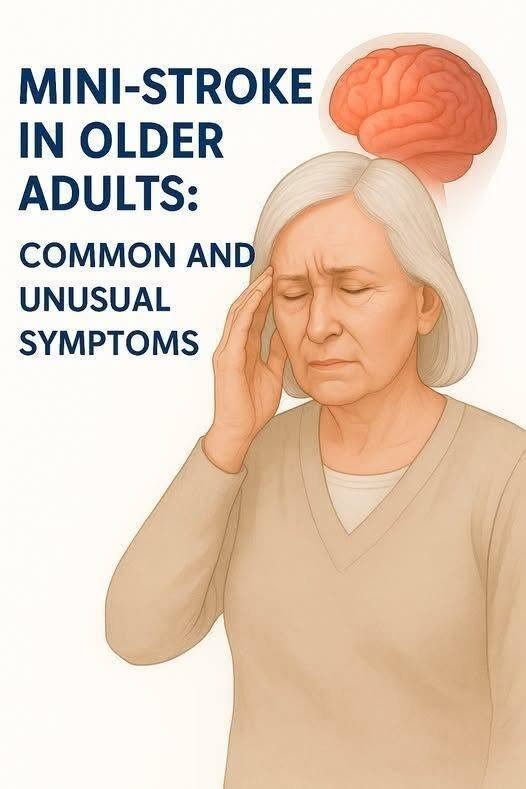
5 Critical Health Signals of a Mini-Stroke in Seniors That Shouldn’t Be Ignored
A transient ischemic attack (TIA) is often called a “mini-stroke,” although medical organizations increasingly describe it as a warning stroke. A TIA occurs when blood flow to part of the brain is temporarily disrupted, producing symptoms similar to those of a stroke. The symptoms may disappear within minutes or hours, but that does not mean the event is harmless.
A TIA can be an important warning that a person is at increased risk of having a full stroke. Because it is impossible to reliably distinguish a TIA from an ongoing stroke at the beginning, sudden neurological symptoms should be treated as a medical emergency.
For older adults and their families, recognizing the warning signs quickly can make an important difference.
1. Sudden Weakness or Numbness on One Side
One of the most recognizable warning signs is the sudden appearance of weakness or numbness, particularly affecting one side of the body.
This may involve:
One side of the face
One arm
One leg
Several areas on the same side
For example, an older adult may suddenly struggle to lift one arm, notice that one hand feels unusually weak, or develop facial numbness or drooping.
The important clue is the sudden onset. A new neurological change that appears unexpectedly should not simply be attributed to aging or fatigue.
A Simple Check
Ask the person to smile and raise both arms.
If one side of the face droops or one arm cannot be held up normally, seek emergency medical help immediately.
2. Sudden Trouble Speaking or Understanding
A TIA can temporarily interfere with the brain’s language functions.
A person may suddenly:
Slur their speech
Have difficulty finding words
Speak in a way that is difficult to understand
Struggle to form sentences
Have trouble understanding what another person is saying
Sometimes the change can be subtle. Someone who normally communicates clearly may suddenly sound confused or unable to express a simple thought.
Speech problems are part of the classic FAST stroke warning system and should never be ignored simply because they resolve.
3. Sudden Vision Changes
A sudden change in vision can also be a warning sign.
A person may experience:
Sudden blurred vision
Double vision
Loss of vision in one eye
Loss of vision affecting part or all of the visual field
Because vision changes can have many possible causes, they should not automatically be assumed to represent a TIA. However, when vision loss or disturbance occurs suddenly—particularly alongside weakness, speech difficulty, dizziness, or other neurological symptoms—it requires urgent assessment.
4. Sudden Loss of Balance, Coordination, or Severe Dizziness
Another potential warning signal is a sudden problem with balance or coordination.
An older adult might suddenly:
Have difficulty walking
Stagger or fall
Become unusually dizzy
Lose coordination
Experience sudden vertigo
These symptoms can also result from inner-ear problems, medication effects, dehydration, low blood pressure, or other conditions. Nevertheless, a sudden unexplained neurological change should be assessed urgently, particularly when it occurs together with other stroke warning signs.