Can This Homemade Powder Really Whiten Teeth and Remove Tooth Decay?
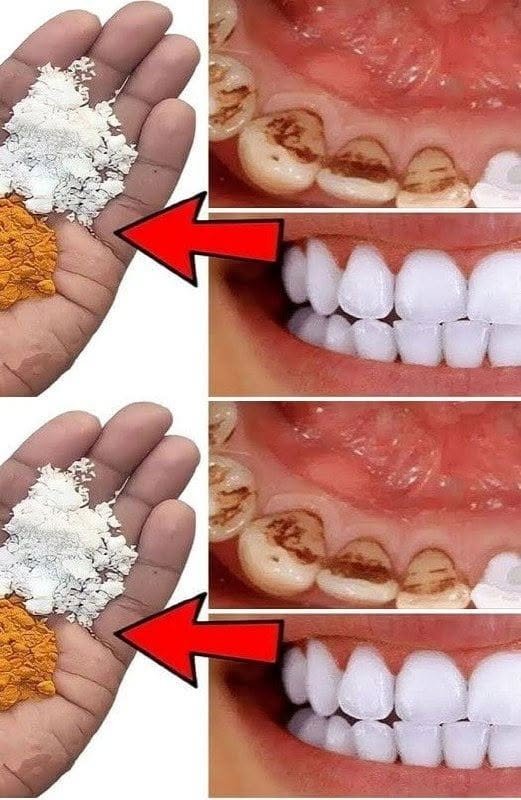
Images like this often make a dramatic promise: a simple white-and-orange powder, supposedly used at home, can transform stained or damaged teeth into a bright, healthy-looking smile.
But when it comes to your teeth, a viral before-and-after image is not enough evidence. Tooth stains, plaque, tartar, and tooth decay are different problems—and they require different approaches.
What the Image Appears to Show
The photographs show teeth with visible brown discoloration and deposits near the gumline, alongside a hand holding a mixture of white and orange-colored substances.
The red arrow strongly suggests that the mixture is being presented as a natural dental-cleaning or whitening remedy.
However, the image alone cannot establish what the powder contains, whether the photographs are genuine before-and-after images, or whether the material actually caused the improvement.
That distinction matters because some discoloration can be surface staining, while other dark areas may represent decay, damaged enamel, or hardened deposits.
Plaque and Tartar Are Not the Same Thing
Plaque is a sticky film containing bacteria that forms on teeth. If it is not removed regularly, it can contribute to tooth decay and gum disease. (nhs.uk)
Over time, plaque can harden into tartar (calculus). Once tartar has formed, ordinary brushing cannot simply dissolve it away. Professional dental cleaning may be needed to remove it. (Ada)
This is one reason homemade powders can be misleading: something that looks like a removable stain may actually require professional treatment.