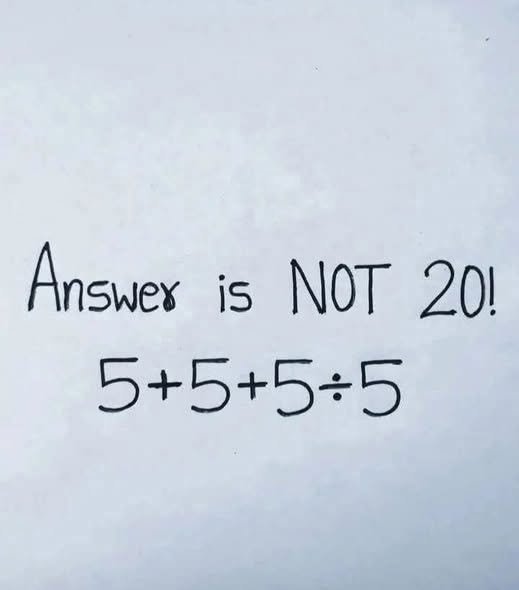
Can You Solve This Math Puzzle Without Falling for the Trick?
The most effective mathematical tricks exploit familiar patterns.
When people encounter a problem that resembles one they have solved before, they often unconsciously apply the same method. This is known as relying on a familiar pattern rather than examining the specific conditions of the problem.
A puzzle might therefore encourage you to:
Identify an apparent mathematical operation.
Apply a familiar formula.
Obtain a plausible-looking answer.
Discover that the reasoning was based on an assumption that was never stated.
The resulting answer may look perfectly reasonable while still being incorrect.
A Better Strategy
A reliable approach is to separate the problem into three stages.
1. Identify the facts
Write down only what the puzzle explicitly tells you. Avoid adding information simply because it seems obvious.
2. Identify the question
Determine precisely what is being requested. Small differences in wording can change the mathematical task entirely.
3. Test your assumptions
Before accepting your answer, ask whether another interpretation of the information could produce a different result.
This final step is particularly important in logic-based mathematics puzzles.
Why These Puzzles Are Valuable
Trick questions are not merely designed to catch people making mistakes. They can be valuable exercises in critical thinking and mathematical communication.
They teach an important principle that extends well beyond mathematics:
A correct conclusion depends not only on performing the calculation correctly, but also on interpreting the information correctly.
In academic study, science, finance, engineering, and everyday decision-making, people frequently encounter incomplete information or statements that can be interpreted in multiple ways. Learning to recognize these situations is an essential analytical skill.
The Real Challenge
The most interesting part of a mathematical puzzle is sometimes not finding the answer, but explaining why the obvious answer is wrong.
A strong solution should therefore do more than provide a number. It should identify the reasoning behind the result, clarify any assumptions, and demonstrate why alternative approaches do or do not work.
That is what separates simple calculation from genuine problem-solving.
Conclusion
The next time you encounter a seemingly easy math puzzle, resist the temptation to calculate immediately. Read the question carefully, separate facts from assumptions, and consider whether the problem contains a hidden condition.
The trick may not be in the mathematics at all.
It may be in the way the question is written.
So, can you solve the puzzle without falling for the trick?