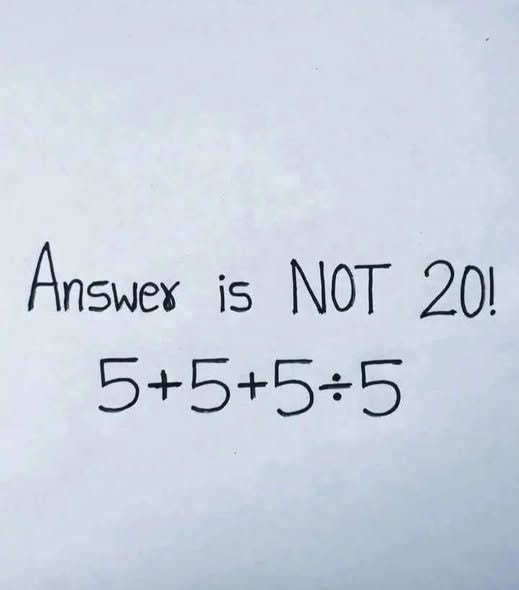
Can You Solve This Math Puzzle Without Falling for the Trick?
Mathematical puzzles are often presented as straightforward exercises in calculation. Yet some of the most challenging problems are not difficult because of complex mathematics—they are difficult because they are designed to make us assume too much, calculate too quickly, or overlook a crucial detail.
The following type of puzzle tests more than numerical ability. It challenges logical reasoning, attention to detail, and the ability to question the assumptions hidden within a seemingly simple problem.
The Importance of Reading Carefully
When faced with a mathematical puzzle, the natural reaction is often to begin calculating immediately. This can be a mistake.
A well-designed puzzle may contain wording that subtly changes the interpretation of the problem. A particular phrase, an unusual condition, or a missing piece of information can completely alter the correct solution.
Before performing any calculation, it is therefore essential to ask:
What information is explicitly provided?
What information am I assuming?
Is there more than one possible interpretation?
Does the question actually ask what I think it asks?
Are all of the given numbers necessary?
These questions may seem simple, but they are often the key to solving deceptive mathematical problems.
Calculation vs. Logical Reasoning
Traditional mathematics frequently rewards a systematic approach: identify the variables, select the appropriate formula, and calculate the result.
Puzzle-solving requires an additional skill—recognizing the structure of the problem itself.
For example, a puzzle may provide several numerical values even though only two are relevant. Alternatively, it may appear to require an elaborate calculation when the answer can be obtained by observing a simple relationship between the quantities.
The challenge is therefore not necessarily to calculate faster, but to determine what actually needs to be calculated.