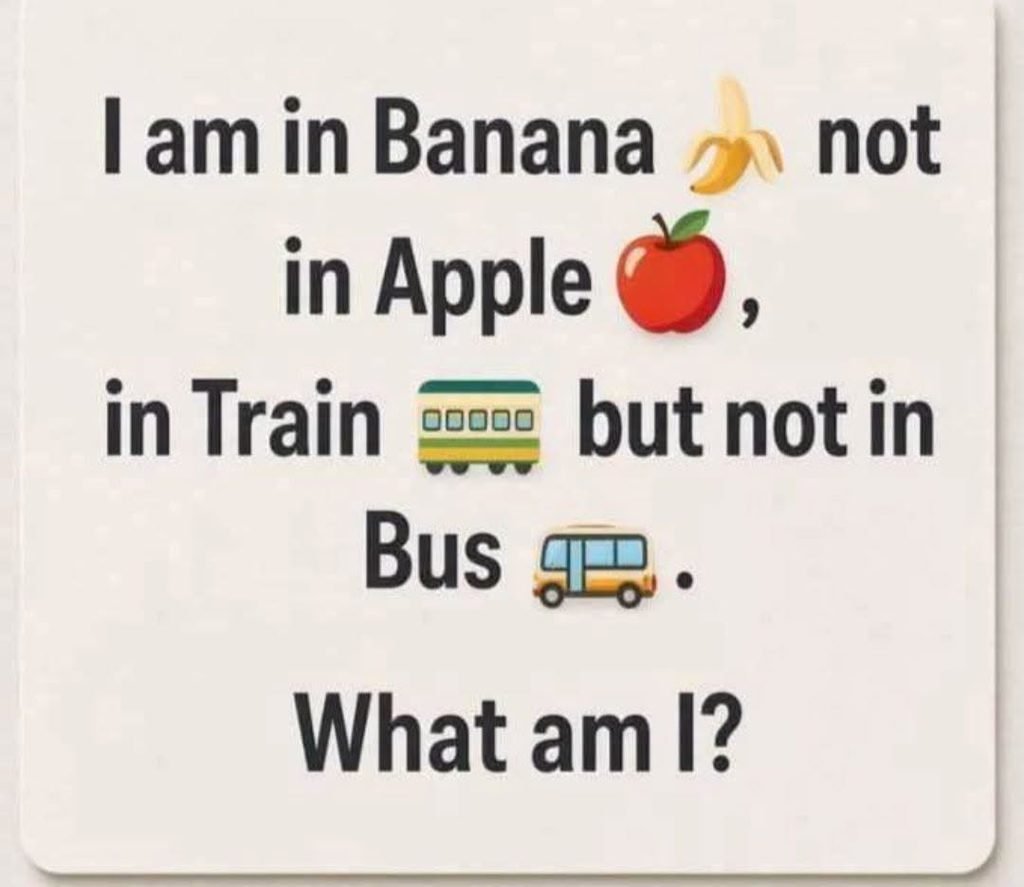
Some riddles are difficult because they require complicated knowledge or elaborate calculations. Others are challenging for a completely different reason: they make us look at ordinary words in an unusual way.
One classic example asks readers to identify something connected to words such as “month,” “minute,” and “moment.” The answer is often surprisingly simple: the letter “N.”
At first glance, the riddle can seem confusing. How could a single letter have anything to do with time? The trick is that the answer is not based on the meaning of the words, but on their spelling.
The Classic Riddle
A common version of the riddle goes something like this:
What comes once in a minute, twice in a moment, but never in a thousand years?
The answer is:
The letter “M.”
This version works because:
minute contains one “m”
moment contains two “m”s
thousand years contains no “m”
However, variations of this riddle sometimes change the wording or use a different target letter. That is why carefully examining the exact words is essential.
Why the Riddle Works
The cleverness comes from a change in perspective.
When people hear words such as minute, moment, or year, they naturally think about time. The brain begins searching for a logical relationship between periods of time.
But the riddle is not really asking about time at all.
Instead, it is asking you to examine the letters inside the words.
This is a classic example of a wordplay riddle, where the apparent subject of the question serves mainly as a distraction. The wording encourages you to think conceptually when the solution is actually linguistic.
The Importance of Spelling
The key is to write the words down and inspect them individually.
For the classic version:
minute → one M
moment → two Ms
a thousand years → no M
Once the words are placed side by side, the solution becomes obvious.
This demonstrates an important feature of riddles: sometimes the information needed to solve the puzzle is already directly in front of you. The challenge is recognizing which part of the wording matters.
Why People Find It Difficult
The riddle is deceptively simple because of the way humans process language.
When someone hears the phrase “once in a minute” or “twice in a moment,” the mind automatically interprets minute and moment according to their meanings.
A person might begin thinking:
Is there a particular second of a minute?
Does something happen twice during a moment?
Is the answer related to clocks?
Does “a thousand years” represent a special historical period?
All of these approaches miss the central trick.
The riddle asks you to stop thinking about what the words mean and start thinking about what they look like.