Those Tiny Holes in Your Shirt May Have a Surprisingly Simple Cause
The Belt and Pants Connection
One particularly common situation occurs when someone regularly wears a shirt tucked into jeans or trousers.
The fabric can become trapped between the body and a metal button, zipper, belt buckle, or another hard surface. Every time you sit down, lean forward, or move around, the same area may rub against that hardware.
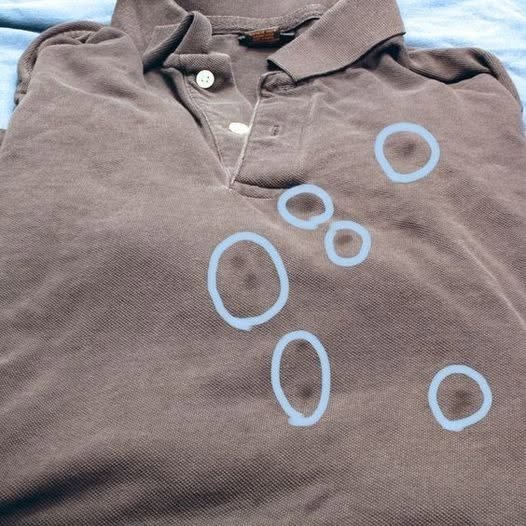
The result can be a collection of small holes concentrated in roughly the same region.
This can explain why a shirt may develop holes even though there are no obvious signs of insects.
Could Moths Be Responsible?
Absolutely—but the image alone doesn’t prove that insects caused the damage.
Clothes moth larvae can damage animal-based fibers such as wool and other keratin-containing materials. Their damage can appear as irregular holes, particularly when clothing is stored undisturbed.
However, if you’re seeing holes repeatedly in the same front area of shirts you wear frequently, mechanical wear deserves serious consideration.
An inspection of the fabric, closet, and other clothing can help narrow down the cause.
Look at the Fabric Around the Holes
There’s a useful clue you can check yourself.
If the fabric around the holes looks thin, fuzzy, or worn, repeated abrasion may be responsible.
If you discover multiple damaged garments stored in the same dark, undisturbed area—and possibly see larvae, webbing, or other signs of an infestation—then insects become more likely.
Don’t focus only on the holes. Look for the pattern.
Why Expensive Shirts Can Develop This Problem
Price doesn’t necessarily protect clothing from friction.
A high-quality cotton polo may have excellent fabric and stitching, yet still develop small holes if the same part of the shirt repeatedly contacts a rough or hard surface.
In fact, very fine fabrics can sometimes show wear surprisingly quickly when exposed to repeated mechanical stress.
That’s why replacing the shirt without identifying the source may simply lead to the same problem with the next one.
How to Prevent More Holes
Once you’ve identified the likely source, prevention becomes much easier.
Check Your Belt
Look at the buckle and any metal edges that contact the shirt.
A rough or protruding edge can gradually abrade fabric.
Check Your Jeans
Pay attention to the metal button at the waist. When the shirt sits directly against it, repeated movement can cause localized wear.
Look at Your Desk
If you’re frequently sitting at a desk, inspect the edge of the desk or countertop. A rough edge can repeatedly rub against the same section of your shirt.
Check Your Seat Belt
A seat belt can also repeatedly press and rub against clothing, particularly during frequent driving.
Wash Carefully
Follow the garment’s care label. Excessive heat, harsh washing, and aggressive drying can weaken fabrics over time and make them more susceptible to damage.
Don’t Automatically Blame the Washing Machine
It’s tempting to assume that a washing machine created every small hole.
Sometimes it can contribute to fabric wear, especially when garments repeatedly encounter rough surfaces or other hardware. But a distinctive concentration of holes in one area often points toward something the shirt is rubbing against during everyday use.
That’s why examining when and where you wear the garment can be more useful than simply changing your detergent.
What About Repairing the Holes?
If the holes are small, they may be repairable before they become larger.
A tailor or experienced seamstress can sometimes use a discreet repair technique, depending on the fabric and location of the damage.
For valuable clothing, repairing the fabric early is usually preferable to waiting until the surrounding material becomes weak.
Final Thoughts
The small holes shown in this shirt don’t necessarily mean there’s an insect infestation.
Repeated friction is an important possibility, particularly when holes appear on the front of shirts around areas that regularly contact belts, buttons, desks, or other hard surfaces.
Before throwing away your favorite shirt, examine the pattern carefully. Check your belt, pants hardware, workspace, and other surfaces that come into contact with the fabric.
Sometimes the culprit isn’t hiding in your closet at all—it’s something you touch every day without even realizing it.