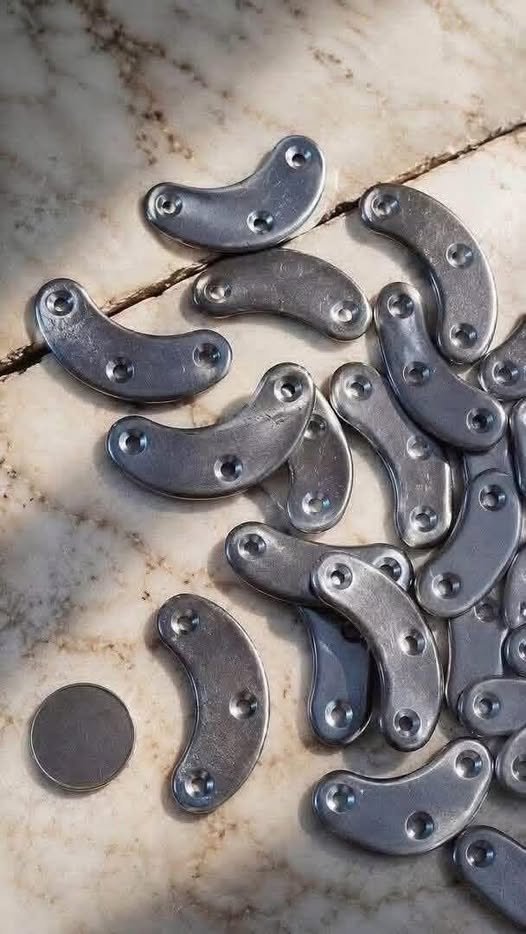
If you encounter one yourself, don’t immediately rely on its appearance alone.
Start by documenting it carefully.
1. Measure It
Record its length, width, height, and approximate weight.
Dimensions can eliminate many possibilities.
2. Photograph Every Side
The underside can be just as informative as the top.
Look for holes, recesses, markings, or unusual wear.
3. Search for Markings
A manufacturer’s name, number, initials, or logo can sometimes provide the strongest identification clue.
4. Examine the Working Surfaces
Ask yourself which surfaces appear to have been intentionally shaped.
A polished or worn area may reveal where another object repeatedly contacted the tool.
5. Consider Its Original Environment
Was it found in an old workshop, garage, farm building, factory, or blacksmith’s shop?
The location can dramatically narrow down the possibilities.
The Viral “99% of People Have No Idea” Claim
Mystery-object posts often use phrases such as “99% of people have no idea what this is” or “Only 1% can identify it.”
These statements are usually designed to create curiosity and encourage people to comment.
Unless a genuine survey or reliable source supports the statistic, there is no reason to take the percentage literally.
The interesting part is not whether exactly 99% of people are confused. The real question is why an ordinary-looking piece of metal can have such a specialized purpose.
So, What Is It Really Used For?
Without seeing the actual object from the original post, it would be irresponsible to identify it with certainty.
A mysterious steel chunk could be a swage block, forming block, die, fixture, anvil-related tool, machinist’s tool, or another specialized piece of workshop equipment. The exact identification depends on its shape, dimensions, holes, grooves, markings, and manufacturing characteristics.
And that is the fascinating lesson behind these mystery-tool puzzles: a piece of steel that looks completely useless may actually be a highly specialized tool designed for a very specific job.
Final Thoughts
The next time you see an old steel block sitting in a workshop or garage, don’t dismiss it as scrap metal.
Its unusual shape may be evidence of a very specific purpose. A hole could have been designed to support a tool. A groove could have shaped metal. A flat surface could have provided a working platform. Even a seemingly random indentation may have been engineered for a reason.
The mystery becomes much easier to solve once you stop asking, “What does this look like?” and start asking: