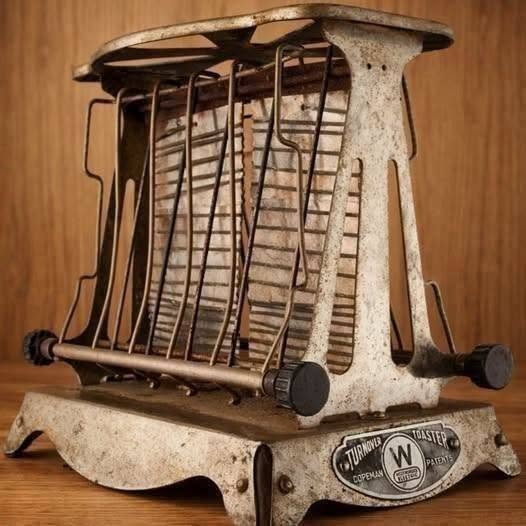
What Is This Vintage Appliance? The History Behind the “Turnover Toaster”
The history of the toaster is essentially a story of increasing automation.
Early models required users to manually manipulate the bread. Later designs introduced mechanisms that could hold the bread in position, regulate the heating period, and eventually release the toast automatically.
The development of the automatic pop-up toaster was an important milestone because it dramatically reduced the amount of attention required.
Instead of standing beside the appliance and monitoring the bread, the user could place the slices inside, activate the mechanism, and return when the toast was ready.
This convenience helped establish the pop-up toaster as a standard kitchen appliance.
Why Vintage Toasters Look So Different
Vintage electrical appliances were often designed with an emphasis on mechanical simplicity and durability.
As a result, older toasters can feature:
Exposed heating elements
Metal frames
Mechanical levers
Hinged racks
Rotating or reversible holders
Bakelite or early plastic components
Decorative metal finishes
Many of these appliances were also designed to be visually attractive.
Kitchen appliances were increasingly becoming permanent objects on countertops, and manufacturers understood that appearance could influence consumer interest.
A Snapshot of Everyday Life
A vintage turnover toaster tells us more than just the history of toast.
It reflects a period when electricity was changing everyday domestic life.
Tasks that had previously required a stove, fire, or considerable manual effort could increasingly be performed with compact electrical appliances.
The toaster therefore belongs to a much larger story involving electric irons, coffee makers, mixers, washing machines, refrigerators, and other household technologies.
Each appliance represented another small step toward the modern kitchen.
Why Collectors Find These Appliances Fascinating
Today, vintage turnover toasters are interesting to collectors of early electrical appliances and kitchen technology.
Their appeal comes partly from their mechanical construction. Unlike many modern appliances, older devices often reveal exactly how they work.
A visible heating element, a hinged mechanism, and a simple metal frame make the appliance’s function easy to understand.
Their appearance also captures the design language of a particular period in technological history.
However, antique electrical appliances should be treated carefully. Old wiring, insulation, plugs, and heating elements can deteriorate over time.
A vintage toaster should not automatically be plugged in simply because it appears intact. Restoration and electrical safety should be evaluated by someone qualified to work with older electrical equipment.
The Legacy of the Turnover Toaster
The turnover toaster may seem primitive compared with today’s appliances, but its basic purpose remains unchanged.
People still want the same thing: a warm, crisp slice of toast for breakfast.
What changed was the technology used to achieve it.
The manual turnover design eventually gave way to increasingly sophisticated mechanisms, including automatic controls, timed heating cycles, spring-loaded pop-up systems, and adjustable browning settings.
Yet the fundamental principle remained remarkably simple: controlled heat transforms bread into toast.
Final Thoughts
The vintage turnover toaster is a fascinating reminder that familiar household appliances did not appear fully developed overnight.
Early electric toasters required users to turn their bread manually because heating technology and mechanical automation were still evolving. Over time, improvements in heating elements, controls, and mechanisms transformed these hands-on devices into the convenient automatic toasters found in kitchens today.
What may look like an unusual antique appliance is therefore actually a small piece of technological history.
It represents a moment when electricity was beginning to reshape everyday life—one slice of toast at a time.