What Is This Vintage Appliance? The History Behind the “Turnover Toaster”
Before modern pop-up toasters became a familiar fixture in almost every kitchen, breakfast appliances often looked very different.
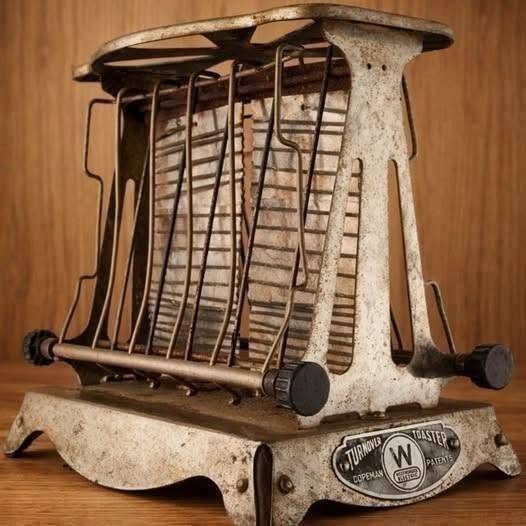
Among the most intriguing examples is the turnover toaster, a vintage appliance designed to toast bread on one side and then allow the user to turn or rotate the bread so the opposite side could be toasted.
Its mechanical design may look unusual today, but the turnover toaster represents an important stage in the development of household electric cooking appliances.
What Is a Turnover Toaster?
A turnover toaster is a type of early toaster in which slices of bread were placed into a holder or rack positioned near exposed heating elements.
Rather than automatically ejecting the toast when it was finished, the user would typically turn, flip, or rotate the bread so that the other side could be exposed to the heat.
This design was especially common during the early development of electric toasters, when manufacturers were experimenting with different ways to make bread toasting faster and more convenient.
Unlike modern enclosed pop-up toasters, many early models had heating elements that were directly visible.
Why Did Early Toasters Need to Be Turned?
The answer lies largely in the technology of the time.
Modern appliances can use multiple heating elements positioned to toast both sides of a slice simultaneously. Early electric toasters were often much simpler.
A basic design might have heating wires positioned on only one side of the bread. Once one side became sufficiently browned, the user had to turn the slice around.
This explains the name “turnover toaster.”
The process was straightforward:
Place the bread in the toaster.
Toast one side.
Turn or flip the bread.
Toast the other side.
Remove the finished slice.
Although this sounds inconvenient compared with modern appliances, it represented a considerable improvement over older methods of preparing toast.
The Rise of Electric Toasting
To understand the turnover toaster, it helps to look at the development of household electricity.
During the late 19th and early 20th centuries, electricity was gradually entering homes in greater numbers. Manufacturers began developing small electrical appliances designed to make everyday household tasks easier.
Electric toasters were among these early appliances.
One of the major technological challenges was developing a heating element that could become hot enough to toast bread while remaining durable and reasonably safe.
Early manufacturers experimented with different heating materials and designs. As these technologies improved, electric toasters became increasingly practical for ordinary households.
The Importance of the Heating Element
The heating element was one of the most important components of an early toaster.
Modern toaster elements are typically designed to glow red or orange as they heat. Early appliances used similar principles but often exposed the heating wires directly to the user.
Materials capable of resisting high temperatures were essential.
One important development involved nichrome, an alloy of nickel and chromium that became widely useful for electric heating applications because of its resistance to oxidation and its ability to withstand high temperatures.
The development of reliable heating elements helped make electric toasters increasingly practical.
Early Toasters Were More Hands-On
Using an early toaster required considerably more attention than using a modern appliance.
There was often no automatic timer, no automatic pop-up mechanism, and no sophisticated temperature control.
The user had to watch the bread carefully and determine when it had reached the desired level of browning.
This meant that making toast was an active process.
The turnover mechanism was therefore not simply a quirky design feature. It was part of a broader period when household appliances were still being developed and refined.