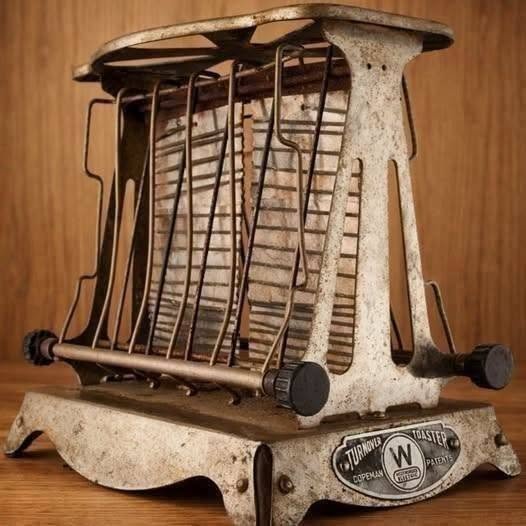
At first glance, this unusual metal device looks more like an old piece of industrial equipment than something that once sat on a kitchen table.
But its purpose was surprisingly simple: it was an early electric toaster.
Long before the familiar pop-up toaster became a standard kitchen appliance, people used designs like this to toast bread over exposed heating elements. The example pictured resembles the early Universal electric toasters made by Landers, Frary & Clark of New Britain, Connecticut. Museums including the Smithsonian and The Henry Ford preserve examples of these appliances dating from the 1910s and early 1920s. (Musée National d’Histoire Américaine)
How Did This Old Toaster Work?
Unlike a modern toaster, this appliance didn’t simply pull the bread down into a slot and automatically pop it back up.
The bread was held in a metal framework close to the heating elements. Some Universal models incorporated a mechanism that allowed the bread cage to rotate, making it possible to toast both sides without taking the bread completely out of the appliance. The Smithsonian describes the E947 model as having a mechanism specifically designed to rotate bread slices horizontally. (Musée National d’Histoire Américaine)
This meant that making toast was much more of a hands-on process than it is today.
A Remarkable Piece of Early Electrical History
The toaster was part of a much larger transformation taking place in American homes during the early 20th century.
As electricity became increasingly useful for household tasks, manufacturers began developing appliances that could perform jobs previously done manually. Landers, Frary & Clark was one of the companies that entered this growing electrical-appliance market. The New Britain Industrial Museum notes that the company introduced products such as electric percolators, irons, toasters, and coffee urns as electricity became more widely adopted. (New Britain Industrial Museum)
The Smithsonian’s collection includes a Universal E945 toaster dated to around 1916, with a listed price of $9 in 1921. (Musée National d’Histoire Américaine)
Why Does It Look So Different From Today’s Toaster?
Modern appliances are designed around convenience and automation. Early electric toasters were much simpler.
Many had:
Exposed heating elements
Metal frames or cages
Manual controls
Mechanical turning mechanisms
Cloth-insulated electrical cords
Decorative metal construction
An early Universal toaster preserved by Historic New England, for example, has metal doors on either side of a central heating element and markings identifying it as a Landers, Frary & Clark Universal appliance. (Historic New England)
The heating elements themselves could use nichrome wire and mica, technology also documented in Smithsonian examples. (Musée National d’Histoire Américaine)
From Manual Toasting to Automatic Pop-Up Toasting
One of the biggest changes in toaster design was the move toward automatic operation.
Early appliances required the user to pay attention to the bread and turn or remove it when necessary. Later designs introduced increasingly sophisticated mechanisms for controlling the process.
By the 1940s, Universal was advertising fully automatic toasters with features such as adjustable browning and a viewing feature that allowed users to inspect the toast without interrupting the cycle. (World Radio History)
That evolution eventually led to the familiar pop-up toaster found in kitchens today.
More Than Just an Old Kitchen Appliance
Today, these early toasters provide a fascinating glimpse into the history of everyday technology.
They show how manufacturers were experimenting with electricity at a time when household appliances were still relatively new. The Henry Ford, for example, has a Landers, Frary & Clark Universal toaster dated 1918–1923 in its collection. (The Henry Ford)