How Many Donkeys Can You See? The Viral Visual Puzzle That Tests Your Observation Skills
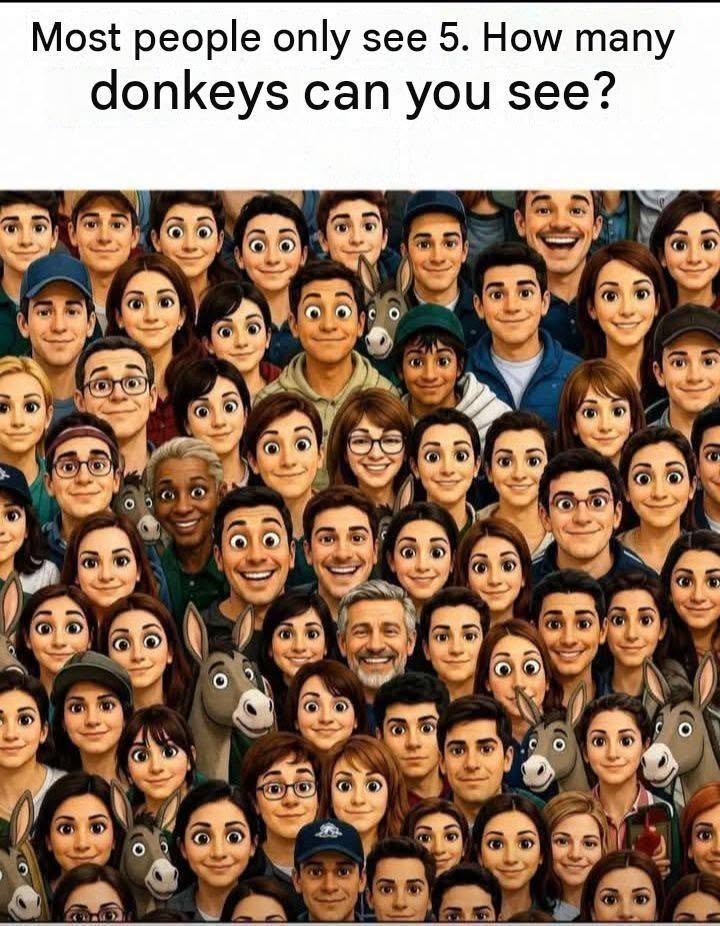
At first glance, the question seems incredibly simple:
How many donkeys can you see?
But visual puzzles like this are rarely as straightforward as they appear. What looks like an ordinary image can contain overlapping shapes, hidden figures, unusual patterns, or cleverly disguised animals that challenge the way we normally look at pictures.
The goal isn’t simply to count what is immediately obvious. It is to slow down, examine the details, and notice what your eyes might initially overlook.
Why Are Hidden-Animal Puzzles So Popular?
Visual puzzles have become extremely popular online because they require almost no explanation.
You simply look at an image and try to solve it.
Unlike traditional quizzes, there is no need for specialist knowledge. You don’t need to remember facts or calculate complicated equations. Instead, the challenge depends primarily on visual attention and observation.
A picture containing several donkeys can therefore become much more difficult than expected if some of the animals are partially concealed or cleverly incorporated into the surrounding scene.
Don’t Count Too Quickly
The biggest mistake people make with visual counting puzzles is answering immediately.
Your brain is extremely good at recognizing familiar objects. When you see an obvious donkey, you identify it almost instantly.
But that same efficiency can work against you.
Once your brain decides what it is looking for, you may unconsciously ignore shapes that don’t immediately resemble the expected object.
That’s why hidden-object puzzles encourage a different strategy: slow down and inspect the entire image.
Look at the Whole Picture
Instead of focusing on the center of the image, examine it systematically.
Start from one corner and slowly move your eyes across the picture.
Look at:
The foreground
The background
The edges
Objects that overlap
Unusual shapes
Shadows and patterns
Partial animal figures
Areas that appear visually crowded
A donkey may not be presented in a perfectly recognizable position. You might see only its head, legs, ears, or body.
Your Brain Can Play Tricks on You
One reason these puzzles are challenging is that human vision isn’t simply a camera recording everything equally.
The brain constantly processes and organizes visual information.
When an image contains many similar shapes, it may group them together or prioritize the most obvious objects. This can make smaller or partially hidden figures surprisingly easy to miss.
This is related to a broader concept known as visual perception—the process through which the brain interprets information received from the eyes.
Hidden Figures Require Attention to Detail
A good puzzle often includes clues that are easy to overlook.
For example, an unusual curve might actually be the back of an animal. Two dark shapes could represent ears. A pattern in the background might contain another figure.
The trick is not necessarily that the image contains a perfectly hidden donkey.
Sometimes the challenge is simply recognizing that a familiar shape is being presented from an unexpected angle.
Try Counting Without Guessing
If you want to test yourself properly, use a simple method.
Step 1: Count the Obvious Ones
First, identify the donkeys that are immediately visible.
Don’t worry about the final answer yet.
Step 2: Divide the Image Into Sections
Mentally separate the picture into smaller areas.
Check each section independently.
This reduces the chance of overlooking something because you’re trying to process the entire image simultaneously.
Step 3: Look for Partial Figures
Pay particular attention to animals that may be partially covered.
A hidden donkey doesn’t necessarily need to be completely visible to count as part of the puzzle.
Step 4: Check the Background
Many people focus almost entirely on the foreground.
That’s exactly why puzzle creators often place clues farther away.
Examine distant objects, spaces between figures, and areas around the edges.
Step 5: Count Again
Once you’ve inspected the entire image, go back and verify your original count.
You may be surprised by what you missed the first time.