How Many Donkeys Can You See? The Viral Visual Puzzle That Tests Your Observation Skills
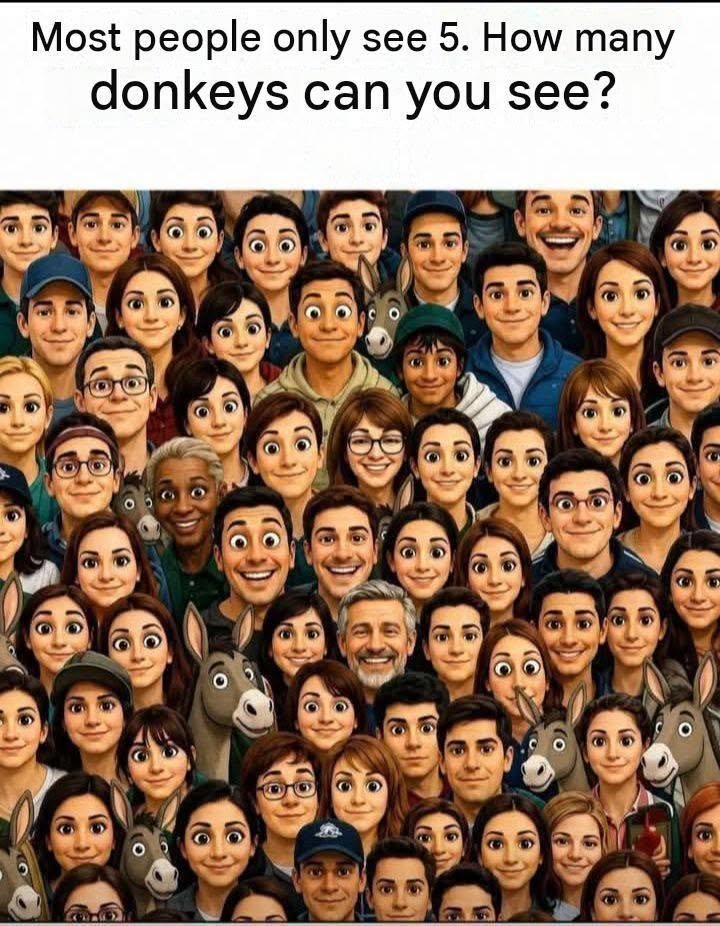
If several people look at the same puzzle, they may produce completely different answers.
One person might count only the obvious donkeys.
Another might notice partially hidden figures.
A third person might interpret an ambiguous shape as an animal while someone else doesn’t.
This is one reason visual puzzles create so much discussion online.
People aren’t necessarily looking at different images. They’re interpreting the same visual information differently.
Is There a “Correct” Answer?
If the puzzle was designed with a specific number of donkeys, there is presumably an intended answer.
However, the answer can sometimes depend on how the creator defines a “donkey.”
Does a partially visible animal count?
What about a reflection?
What if only the head is visible?
What about a shape that resembles a donkey but isn’t clearly identifiable?
These questions can make seemingly simple counting puzzles surprisingly debatable.
The Real Challenge Is Observation
The most valuable part of the puzzle isn’t necessarily getting the final number right.
It’s the process of looking carefully.
Modern life encourages us to process information quickly. We scroll through photographs, videos, advertisements, messages, and headlines in seconds.
A visual puzzle forces us to stop.
It asks us to examine something carefully rather than simply glance at it.
That makes these puzzles entertaining while also providing a simple exercise in concentration.
Challenge Your Friends
Once you’ve found your answer, don’t immediately reveal it.
Send the puzzle to a friend and ask:
“How many donkeys can you see?”
Compare your answers.
You may discover that someone else spotted a figure you completely overlooked.
The disagreement is often more entertaining than the puzzle itself.
Final Thoughts
How many donkeys can you see?
It sounds like an easy question, but the answer depends on how carefully you examine the image.
The obvious figures are usually the easiest to find. The real challenge lies in the details—the shapes, corners, overlaps, and partially hidden objects that your brain may ignore at first glance.
So don’t rush.
Look again.
Count carefully. You might be surprised by how many donkeys were hiding in pl