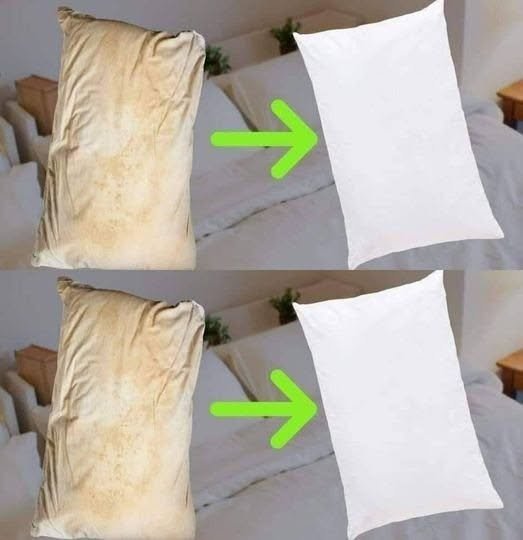
Here’s How to Clean Dirty Bed Pillows to Leave Them White and Smelling Fresh
Over time, even the cleanest-looking bedroom can develop one stubborn problem: dirty, yellowing pillows.
Pillows absorb sweat, body oils, skin cells, saliva, hair products, and other moisture night after night. Eventually, that buildup can leave them looking yellow or gray and smelling less than fresh.
The good news is that many washable pillows can be cleaned at home. The key is knowing what the pillow is made of and following the manufacturer’s care instructions.
Here’s how to refresh dirty bed pillows safely and effectively.
Why Do Pillows Turn Yellow?
Yellowing is usually caused by a combination of perspiration, body oils, moisture, and repeated use.
Even when you shower before bed, your body naturally produces sweat and oils while you sleep. Some of this transfers to your pillowcase and eventually reaches the pillow itself.
Moisture can also contribute to discoloration and odors, particularly if the pillow doesn’t dry completely between washes.
Yellowing doesn’t necessarily mean that a pillow is dangerously dirty. It is often simply a sign that the fabric and filling have accumulated normal household buildup over time.
Check the Care Label First
Before washing a pillow, check its care label.
This is the most important step because different fillings require different cleaning methods.
Some common pillow types include:
Polyester or synthetic fiber
Down
Feather
Memory foam
Latex
Wool
Specialty or orthopedic fillings
Many synthetic, down, and feather pillows can be machine washed, but memory foam and latex pillows generally should not be put through a washing machine.
If the label says “spot clean only,” “dry clean,” or provides specific washing instructions, follow those directions instead.
What You’ll Need
For many washable fabric pillows, you may need:
Regular laundry detergent
Washing machine
Clean towels
Baking soda, optional
Oxygen-based laundry whitener, optional and only if compatible with the care label
Dryer or a well-ventilated drying area
Avoid combining cleaning products simply because a viral cleaning recipe recommends it. More chemicals do not necessarily mean a cleaner pillow.
Step 1: Remove the Pillowcase and Protector
Take off the pillowcase and any protective cover.
Wash these separately according to their care instructions.
A pillow protector is particularly useful because it creates an additional washable barrier between your body and the pillow itself.
Using one can reduce the amount of sweat, oils, and other residue that reaches the pillow.
Step 2: Inspect the Pillow
Before washing, examine the pillow carefully.
Look for:
Tears or damaged seams
Clumping
Persistent stains
Mold or mildew
Unusual odors
Signs that the filling is deteriorating
If the pillow is badly damaged, washing it may make the problem worse.
If you see extensive mold or mildew, replacing the pillow may be more appropriate than attempting to restore it at home.
Step 3: Pre-Treat Visible Stains
If there are obvious stains, gently pre-treat them using a suitable laundry stain remover.
For stubborn yellowing, an oxygen-based bleach product may be appropriate for some washable fabrics.
Always check the product label and pillow care instructions first.
Avoid automatically reaching for chlorine bleach. It can damage certain fabrics and fillings and isn’t appropriate for every pillow.
Step 4: Wash Washable Pillows
If the pillow is machine washable, use the recommended water temperature and cycle from the care label.
Use a moderate amount of regular laundry detergent.
Avoid adding excessive detergent. Too much detergent can leave residue behind and may make thorough rinsing more difficult.
If you’re washing multiple pillows, balance the machine properly rather than stuffing it too full.
For down and feather pillows, gentle washing and thorough rinsing are especially important.
What About Baking Soda?
Baking soda is sometimes recommended as a universal pillow-cleaning solution.
It can help with odors when used appropriately, but it isn’t a magical whitening treatment.
If you want to use baking soda, follow the care instructions for the pillow and avoid mixing it indiscriminately with other cleaning chemicals.
For persistent discoloration, a suitable oxygen-based laundry product may be more effective than baking soda alone.