The ‘World’s Deadliest Food’ Claims Over 200 Lives Every Year, Yet Nearly 500 Million People Still Eat It
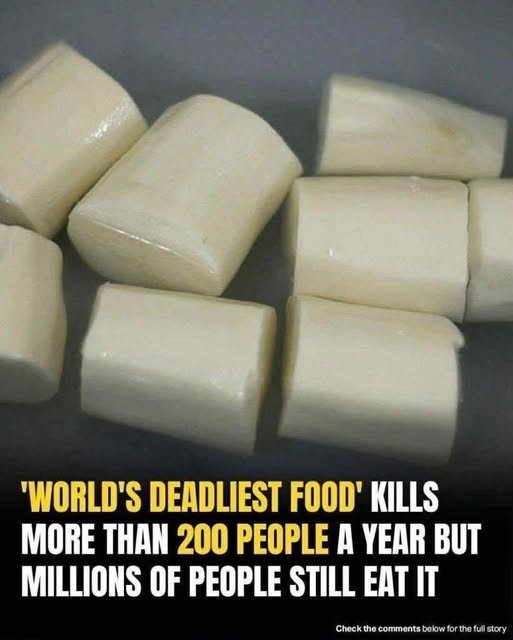
At first glance, cassava looks like an ordinary root vegetable. It is starchy, filling, inexpensive, and remarkably adaptable. Across Africa, Latin America, and parts of Asia, it has been an important source of food and income for generations. Researchers estimate that cassava provides a significant source of energy for roughly 500 million people worldwide. (IADNS)
Yet cassava also has a dangerous side. When certain varieties are eaten raw or processed incorrectly, naturally occurring compounds in the plant can release hydrogen cyanide, a highly toxic substance. This is the reason cassava has sometimes been sensationally described in popular media as the “world’s deadliest food.” (FOODbible)
🌱 What Is Cassava?
Cassava (Manihot esculenta) is a tropical root crop originally from South America. Today, it is cultivated extensively throughout tropical regions.
The root is rich in starch and carbohydrates, making it particularly valuable in areas where other crops may be difficult to grow. Cassava is also relatively drought-tolerant and can produce food under challenging agricultural conditions. FAO materials have described it as an important staple providing basic food for around 500 million people. (FAOHome)
It can be prepared in many forms, including boiled or fried pieces, porridges, fermented foods, and flour. Cassava starch is also used to make products such as tapioca.