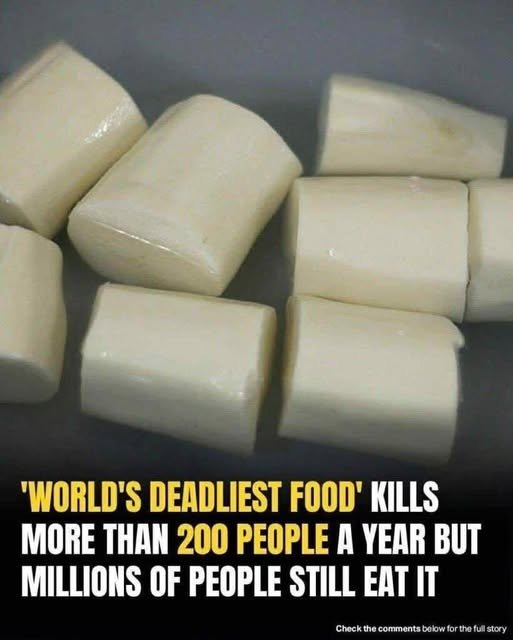
The ‘World’s Deadliest Food’ Claims Over 200 Lives Every Year, Yet Nearly 500 Million People Still Eat It
☠️ Why Can Cassava Be Dangerous?
The danger comes from cyanogenic glycosides, naturally occurring compounds that can release cyanide when cassava tissue is damaged, processed, or digested.
The concentration is not the same in every plant. Some varieties contain considerably more cyanogenic compounds than others, with so-called “bitter” varieties generally presenting greater toxicity concerns than many “sweet” varieties. (LADbible)
Eating improperly prepared cassava can therefore result in cyanide poisoning. Severe exposure can cause symptoms such as headache, dizziness, vomiting, weakness, confusion, difficulty breathing, seizures, and potentially death.
There is also a longer-term concern. Repeated exposure to insufficiently processed cassava, particularly in vulnerable populations with poor nutrition, has been associated with konzo, a neurological disorder characterized by sudden and permanent weakness or paralysis of the legs. (Tiny House Zone)
🍽️ So Why Do Hundreds of Millions of People Eat It?
Because properly processed cassava is an important food—not a poisonous food that people routinely consume at their own peril.
For generations, communities that depend on cassava have developed methods for reducing its cyanogenic compounds. Depending on the variety and local tradition, these methods can include peeling, soaking, fermenting, drying, grating, and thorough cooking.
Research reviewing cassava safety emphasizes that processing is central to reducing the toxic compounds and making cassava products suitable for consumption. (Frontiers)
This distinction is important: the problem is primarily improper processing, rather than cassava simply being inherently deadly.
⚠️ Raw Cassava Is Not the Same as Properly Prepared Cassava
One of the biggest mistakes is assuming that cassava can be treated exactly like a potato.
Raw cassava should not simply be eaten after peeling. Its cyanogenic compounds need to be reduced through appropriate processing.
This is particularly important with bitter varieties, which can contain substantially higher levels of cyanogenic compounds than sweeter varieties. (LADbible)
For this reason, anyone unfamiliar with cassava should follow established preparation instructions for the particular variety and product rather than experimenting with preparation methods.
🌍 Why Is Cassava So Important?
Cassava’s popularity isn’t difficult to understand.
It grows well in tropical climates, can tolerate relatively poor soils, and can remain in the ground for extended periods. Those characteristics make it particularly valuable as a food-security crop.
FAO sources describe cassava as an important calorie source in tropical regions, while research literature identifies it as a major staple for hundreds of millions of people. (FAOHome)
In other words, cassava’s story isn’t simply about danger. It is also a story about food security, agriculture, tradition, and survival.
🧪 What About the “200 Deaths a Year” Claim?
The frequently repeated figure of more than 200 deaths per year appears in numerous online articles discussing cassava poisoning. (UNILAD)
However, this number should be treated cautiously. Cassava poisoning can be underreported, and estimates vary depending on the country, surveillance system, definition of poisoning, and available health data. A recent systematic review also notes the difficulty of measuring mortality associated with cassava and cassava-based products across different studies. (Frontiers)
So the headline is attention-grabbing, but it should not be interpreted as meaning that hundreds of millions of people are routinely putting themselves in serious danger simply by eating cassava.
🥔 Is Cassava Nutritious?
Cassava is primarily an energy-producing carbohydrate food because its roots are rich in starch.
It can contribute useful nutrients, including vitamin C and some minerals, but cassava is relatively low in protein. For that reason, diets that rely heavily on cassava benefit from being combined with protein-rich foods, legumes, vegetables, fruits, and other nutrient sources. (IADNS)
🚨 Who Should Be Especially Careful?
Anyone preparing cassava should be cautious about:
Eating cassava raw
Using unfamiliar or bitter varieties without knowing how they should be processed
Skipping established preparation steps
Assuming that peeling alone makes cassava safe
Eating cassava products that have been improperly processed
If someone develops symptoms of possible poisoning after eating cassava, particularly severe vomiting, dizziness, confusion, breathing problems, seizures, or collapse, urgent medical attention is necessary.
The Bigger Lesson
Calling cassava the “world’s deadliest food” makes for a striking headline, but the reality is more nuanced.
Cassava has helped feed hundreds of millions of people because it is resilient, versatile, and capable of producing substantial amounts of food in challenging environments. Its natural toxins are a genuine food-safety concern, but traditional and scientifically supported processing methods can substantially reduce that risk. (IADNS)
The real lesson isn’t that people should be afraid of cassava. It is that some foods require proper preparation before they are safe to eat.
Cassava is one of the clearest examples: a crop that can be both hazardous when mishandled and enormously valuable when prepared correctly.
Important: This article is for general educational purposes. Cassava varieties differ in their cyanogenic content, so preparation should follow reliable food-safety guidance appropriate to the variety and region.