Sign 6: Nausea and Vomiting Without Apparent Cause
While less commonly highlighted than facial droop or arm weakness, sudden nausea and vomiting can be a warning sign of a stroke, particularly when they occur alongside dizziness, headache, or visual disturbances . The NHS lists feeling or being sick as a possible symptom of stroke . This symptom is often associated with strokes affecting the posterior circulation (the back of the brain), which can disrupt the vestibular system and trigger severe nausea. Because nausea and vomiting have countless benign causes—food poisoning, a stomach bug, motion sickness—they are rarely the first thing a person thinks of when considering stroke. However, when they appear suddenly and are accompanied by any neurological symptom, they should be treated as a potential emergency.
Sign 7: Cognitive Changes and Memory Loss
A stroke can cause sudden confusion, disorientation, or difficulty with memory and information processing. The NHS notes that confusion and memory loss are possible symptoms of a stroke . A person may suddenly be unable to recall recent events, may appear disoriented in familiar surroundings, or may struggle to follow simple instructions. These cognitive changes are caused by disrupted blood flow to areas of the brain involved in memory and executive function. While cognitive decline is often associated with aging or dementia, a sudden change in mental status is a hallmark of a vascular event and requires immediate medical attention. It is not a normal part of aging; it is a neurological emergency.
Sign 8: Weakness or Numbness Down One Side of the Body
This sign is related to Sign 1 but encompasses the entire side of the body. The NHS explicitly lists “weakness or numbness down 1 side of your body” as a symptom of stroke . This can affect the face, arm, and leg simultaneously, or it may affect the trunk and limbs. A person may feel as though an entire half of their body has “gone to sleep” or is not responding properly. This pattern of symptoms points to a lesion in the brain or brainstem that affects the crossed pathways controlling sensation and movement. It is a classic presentation of a stroke and a clear indication for emergency intervention.
Sign 9: Difficulty Swallowing or Drooling
While not always included in the standard FAST acronym, difficulty swallowing (dysphagia) and drooling can be warning signs of a stroke affecting the brainstem or the cranial nerves that control swallowing. A person may suddenly find it difficult to swallow food or liquids, may choke easily, or may have a loss of sensation in the mouth and throat that leads to drooling. This symptom is particularly dangerous because it can lead to aspiration (inhaling food or liquid into the lungs), which can cause pneumonia. Any sudden change in swallowing ability should be evaluated urgently.
Sign 10: A TIA (Mini-Stroke) Itself
The tenth “sign” is the TIA itself. A transient ischemic attack is the most powerful warning sign of an impending stroke . If a person experiences any of the symptoms above and they resolve completely within minutes to hours, that event is a TIA. It is not a “false alarm.” It is a medical emergency that requires immediate evaluation to determine the cause and initiate preventive treatment. The risk of a major stroke is highest in the first 48 hours after a TIA, and it remains elevated for weeks and months . Ignoring a TIA because the symptoms have passed is one of the most dangerous mistakes a person can make.
Conclusion
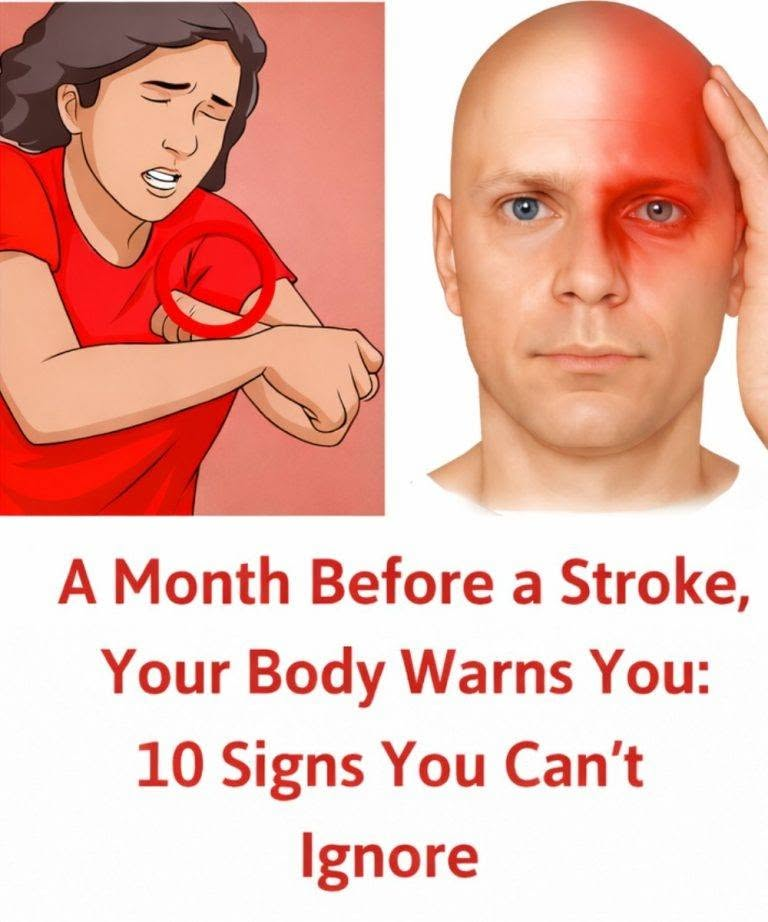
The claim that the body warns you a month before a stroke is not entirely accurate in a literal sense, but the underlying message is profoundly true: the body does send warnings, often in the form of a TIA, and those warnings can occur days or weeks before a catastrophic event. The ten signs outlined here—unilateral weakness, speech difficulty, vision changes, severe headache, dizziness, nausea, cognitive changes, bodily numbness, swallowing difficulty, and the TIA itself—are not a checklist to be casually reviewed and set aside. They are a call to action. If you or someone you love experiences any of these symptoms, even briefly, do not wait. Call emergency services immediately. The window for intervention is narrow, but acting swiftly can prevent a lifetime of disability. Your body is speaking; listen to it.
Frequently Asked Questions
Can a stroke really be predicted a month in advance?
A stroke cannot be predicted with certainty a month in advance, but a TIA (mini-stroke) can occur days or weeks before a major stroke and serves as a critical warning sign . Some people also experience subtle, nonspecific symptoms like dizziness or fatigue in the weeks preceding a stroke, but these are not reliable predictors .
What is the difference between a TIA and a stroke?
A TIA is a temporary blockage of blood flow to the brain that causes stroke-like symptoms but resolves without permanent damage. A stroke causes lasting tissue death and disability. A TIA is a major risk factor for a future stroke .
What is the FAST test?
FAST stands for Face, Arms, Speech, and Time. It is a rapid assessment tool: check for facial drooping, ask the person to raise both arms (checking for weakness), listen for slurred or confused speech, and if any of these are present, call emergency services immediately .
What should I do if symptoms disappear?
If stroke symptoms disappear, it may have been a TIA. You should still seek emergency medical evaluation immediately. The risk of a major stroke is highest in the hours and days following a TIA .
Can young people have strokes?
Yes. While stroke risk increases with age, strokes can occur at any age. The NHS notes that a stroke is more likely to happen if you are older, but it can happen at any age .
Are stroke symptoms different for women?
Yes, women may experience additional or atypical symptoms, including general weakness, fatigue, nausea, vomiting, fainting, confusion, or sudden behavioral changes .
What are the most common risk factors for stroke?
High blood pressure, high cholesterol, diabetes, smoking, heart disease (especially atrial fibrillation), and a family history of stroke are major risk factors. Managing these conditions is key to prevention.