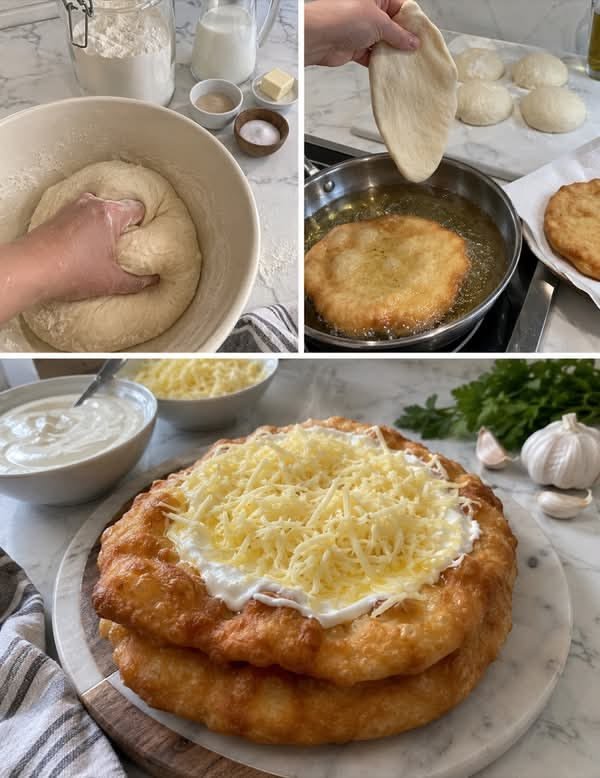
Combine the warm water or milk, yeast, and sugar in a small bowl. Let stand for about 5–10 minutes, until the yeast becomes slightly foamy.
In a large bowl, combine the flour and salt.
Add the yeast mixture and vegetable oil. Mix until a soft dough forms.
Knead for approximately 8–10 minutes, until smooth and elastic.
Cover the bowl and let the dough rise in a warm place for about 1 hour, or until it has roughly doubled in size.
2. Divide the Dough
Transfer the risen dough to a lightly floured surface.
Divide it into approximately 6–8 equal portions.
Shape each portion into a ball.
Cover the dough balls and allow them to rest for another 10–15 minutes.
3. Shape the Lángos
Take one dough ball and gently stretch it with your hands.
Work from the center outward, leaving the middle slightly thinner and the edges somewhat thicker.
The finished piece should be roughly round and about the size of a small plate.
Avoid using too much flour while shaping—the dough should remain soft.
4. Fry the Lángos
Heat a generous amount of vegetable oil in a deep skillet over medium-high heat.
Carefully place one stretched piece of dough into the hot oil.
Fry for approximately 1–2 minutes per side, until beautifully golden brown and puffed.
Remove with tongs or a slotted spoon and place on paper towels to drain excess oil.
Repeat with the remaining dough.
The Classic Hungarian Topping
While the lángos is still warm, rub the surface with fresh garlic.
Spread a generous layer of sour cream over the top.
Finish with plenty of freshly grated cheese.
A small sprinkle of salt brings all the flavors together.
The combination of the crispy fried dough, cool sour cream, fragrant garlic, and melted cheese is what makes classic lángos so irresistible.
Popular Lángos Variations
Although garlic, sour cream, and cheese are among the most familiar toppings, lángos can be customized in many ways.
Garlic Lángos
Rub the freshly fried bread with crushed garlic or brush it with garlic-infused oil.
Cheese and Sour Cream Lángos
The classic combination of creamy sour cream and grated cheese is perfect for a traditional serving.
Ham and Cheese
Add thinly sliced ham beneath the cheese for a more substantial meal.
Potato Lángos
Potato can be incorporated into the dough, creating a softer and more substantial version.
Sweet Lángos
Modern variations can be topped with powdered sugar, jam, or other sweet ingredients, although savory versions are the traditional favorite.
Tips for Perfect Lángos
Let the dough rise properly
A well-risen dough produces the characteristic light and airy interior.
Don’t make the dough too thick
The center should remain tender while the outside becomes crisp and golden.
Keep the oil at the right temperature
Oil that is too cool can make the lángos greasy, while oil that is too hot can brown the outside before the inside cooks properly.
Stretch the dough by hand
Gently stretching the dough creates the irregular, rustic shape associated with traditional lángos.
Serve immediately
Lángos is best enjoyed fresh and hot, when the exterior is crisp and the inside is still soft.
A Little Hungarian Food History
Lángos has deep roots in Central European baking traditions. Its name is connected with the Hungarian word “láng,” meaning flame, reflecting its historical association with bread-making.
Traditionally, pieces of dough were baked near the flames of a bread oven. Over time, the modern deep-fried version became particularly popular as a street food.
Today, lángos is a familiar sight at Hungarian markets, festivals, thermal baths, fairs, and food stalls.
For many people, the smell of freshly fried lángos immediately brings back memories of summer trips, family outings, and Hungarian holidays.
What to Serve With Lángos
Lángos is excellent on its own, but it also pairs beautifully with traditional accompaniments such as:
Pickled cucumbers
Pickled peppers
Fresh tomatoes
Cucumber salad
Sausages
Hungarian paprika
A cold glass of your favorite drink
For the classic experience, however, garlic + sour cream + cheese is hard to beat.
Frequently Asked Questions
Can I prepare lángos dough ahead of time?
Yes. The dough can be refrigerated after rising and used later. Allow it to come closer to room temperature before shaping.
Can lángos be baked instead of fried?
It can, but baked lángos has a different texture. The traditional version is deep-fried, which gives it its characteristic crisp exterior.
Why is my lángos greasy?
The oil may not have been hot enough when the dough was added. Maintaining a steady frying temperature helps prevent excessive oil absorption.
Can I freeze lángos?
For the best texture, freshly fried lángos is recommended. The dough itself can be prepared ahead and frozen, then thawed before shaping and frying.
What cheese should I use?
A mild melting cheese such as mozzarella, Edam, or a Hungarian-style semi-hard cheese works well. Freshly grated cheese melts particularly nicely over hot lángos.
Final Thoughts
Hungarian Lángos is proof that simple food can be incredibly memorable.
A soft, yeast-risen dough is stretched by hand, fried until golden, rubbed with garlic, covered with cool sour cream, and finished with a generous layer of cheese.
The contrast of crispy edges, fluffy dough, creamy sour cream, sharp garlic, and melted cheese makes every bite satisfying.
Whether enjoyed at a Hungarian festival or made at home for the family, lángos brings the unmistakable flavor of Hungarian street food straight to the table. 🇭🇺❤️
Fresh, golden, garlicky, cheesy, and best eaten hot—this is Hungarian comfort food at its finest.