The Simple Steak Trick That Can Make a Big Difference: When and How to Salt Your Meat
Salt Well in Advance
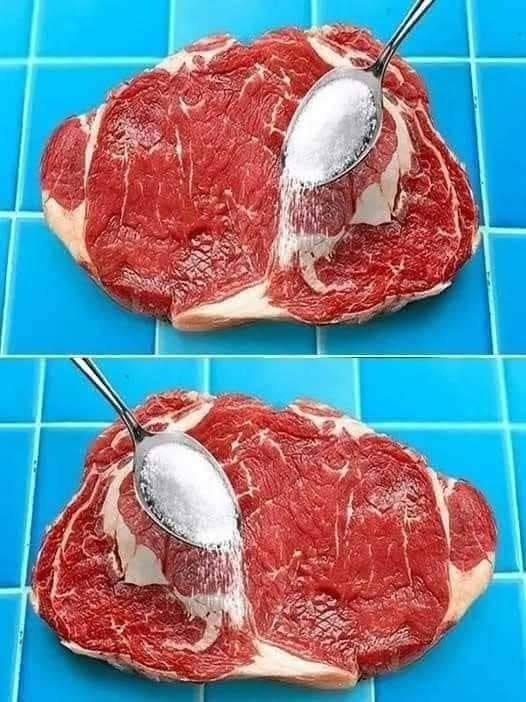
For an even more deliberate approach, many cooks salt the steak well ahead of time, allowing the salt to work into the meat before cooking.
This is often called dry brining.
Instead of leaving the steak sitting for only a few minutes, the seasoning has time to interact with the meat. The surface should then be dried before cooking so the steak can develop better browning.
What About the Orange Powder?
The image also appears to show an orange-colored seasoning beside the white salt.
Without knowing the original recipe or seeing the ingredient label, it isn’t possible to identify that powder with certainty. It could be a spice blend, paprika, chili powder, seasoning salt, or another ingredient.
That is important because viral cooking images often leave out the actual quantities and ingredients.
If you’re preparing steak, use seasonings based on the recipe rather than assuming every ingredient shown in a viral image is necessary.
Does Salt Actually Tenderize Steak?
This is where online claims can become exaggerated.
Salt can influence the texture of meat, particularly when used as part of a controlled dry-brining process. However, the tenderness of a steak depends on many factors, including:
The cut of beef
The amount of connective tissue
Marbling
Aging
Cooking temperature
Final internal temperature
Resting after cooking
How the steak is sliced
A naturally tender cut such as ribeye or tenderloin doesn’t need the same treatment as a tougher cut.
The Secret to a Great Crust
There’s another reason salting properly matters: surface moisture.
A wet steak tends to spend some of its cooking energy evaporating water before it can brown effectively. A dry surface makes it easier to develop the deep brown crust associated with well-seared steak.
Before cooking:
Pat the steak thoroughly dry.
Season appropriately.
Heat your pan or grill well.
Add the steak.
Avoid constantly moving it around.
Allow a good crust to develop before turning.
That combination can make a bigger difference than any mysterious “secret powder.”
Don’t Forget Food Safety
Because the image shows raw meat, food safety is just as important as seasoning.
Keep raw beef separate from ready-to-eat foods, wash your hands and utensils after handling raw meat, and use a food thermometer when you need to verify doneness.
For whole cuts of beef, the USDA recommends a minimum internal temperature of 145°F (63°C), followed by a three-minute rest. Ground beef has a higher recommended minimum temperature because grinding can distribute bacteria throughout the meat.
If you want to experiment with the method shown in the image, keep it simple.
Use a good-quality steak, season it with salt, and give the seasoning enough time to work rather than immediately covering the meat with a large amount of random ingredients.
Then pat the surface dry and cook it using a hot pan or grill.
You may find that proper seasoning and good cooking technique are responsible for much of the improvement that viral “steak hacks” attribute to a secret ingredient.
Final Thoughts
The spoonful of salt in this viral image isn’t necessarily a gimmick. Salting steak is a fundamental cooking technique, and dry brining can be an excellent way to improve seasoning and help produce a flavorful crust.
But there is no magic combination that guarantees every steak will become exceptionally tender.
The real formula is much simpler: choose the right cut, salt appropriately, control moisture, use sufficient heat, cook to the desired temperature, and let the steak rest.
Sometimes the most impressive cooking tricks aren’t complicated at all—they’re simply techniques that have been used correctly.