What Are Those Strange White Clusters Under the Bed? A Closer Look at a Hidden Pest Problem
Could They Be Bed Bug Eggs?
The location naturally raises the question of bed bugs.
Bed bugs do lay small white, oval eggs in cracks and crevices, generally close to places where people sleep or rest. An adult female can lay roughly 200–250 eggs during her lifetime. (Extension de l’Université du Minnesota)
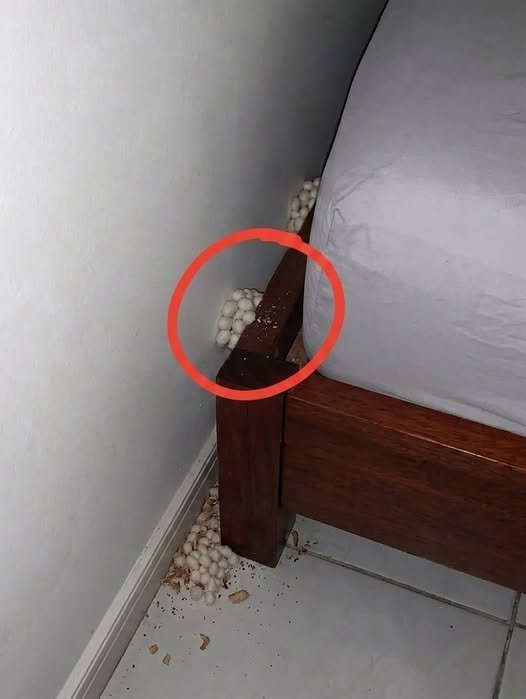
But the photograph does not provide enough detail to conclude that these are bed bug eggs.
Bed bug eggs are extremely small—about 1/16 inch long—and are normally found individually or in small groups attached to surfaces rather than appearing as large clusters of conspicuous white spheres. (Extension de l’Université du Minnesota)
So it’s important not to automatically label every collection of white objects near a bed as bed bug eggs.
The Location Is Still an Important Clue
Even if these aren’t bed bug eggs, finding biological material around a bed frame deserves attention.
The best approach is to inspect the surrounding area carefully.
Look at:
The underside of the mattress
Mattress seams
Bed-frame joints
Cracks in the wall
Behind the headboard
Baseboards
Nearby furniture
Carpet edges
Areas underneath the bed
Use a flashlight and look for additional evidence rather than focusing only on the white clusters.
What Else Should You Look For?
If insects are responsible, you may find other clues nearby.
Depending on the pest, these could include:
Live insects
Shed skins
Webbing
Droppings or dark spots
Additional egg cases
Small insects hiding in cracks
For suspected bed bugs specifically, inspecting mattress seams and nearby cracks is particularly important because bed bugs typically hide close to places where people sleep. (Extension de l’Université du Minnesota)
Don’t Crush or Handle Unknown Material With Bare Hands
If you discover an unfamiliar egg mass or nest, it’s better to avoid touching it directly.
Take a clear close-up photograph first. If possible, photograph it alongside a ruler or coin to show its size.
That information can make identification considerably easier.
If there are many clusters or you find live insects, professional pest identification may be worthwhile.
Clean the Area—But Don’t Stop There
Vacuuming visible debris and cleaning around the bed can remove some pests and their hiding places.
University of Minnesota Extension recommends removing spider webbing and egg sacs when dealing with household spiders, while also reducing clutter and sealing cracks and gaps that can provide hiding places. (Extension de l’Université du Minnesota)
But simply cleaning the visible area may not solve the problem if insects are entering through a crack or reproducing somewhere nearby.
Why You Shouldn’t Immediately Reach for Pesticides
The first step should be identification.
Different pests require different treatments, and spraying an unidentified substance can expose people and pets to unnecessary chemicals without addressing the source.
If the infestation is extensive or the pest cannot be identified, a qualified pest-control professional can determine what you’re dealing with and recommend an appropriate treatment.
Final Thoughts
Those unusual white clusters tucked behind the bed are definitely worth investigating, but the photograph alone isn’t enough to identify them with certainty.
They could represent egg cases or another biological material associated with a household pest, and the fact that they are clustered in a protected space makes further inspection sensible.
If you discover something similar in your own home, don’t panic and don’t assume it’s bed bugs immediately. Take a close-up photograph, inspect the surrounding area carefully, and look for the adult insect or other signs that can reveal the real culprit.
Sometimes the most important clue isn’t the strange cluster itself—it’s what you find hiding nearby.