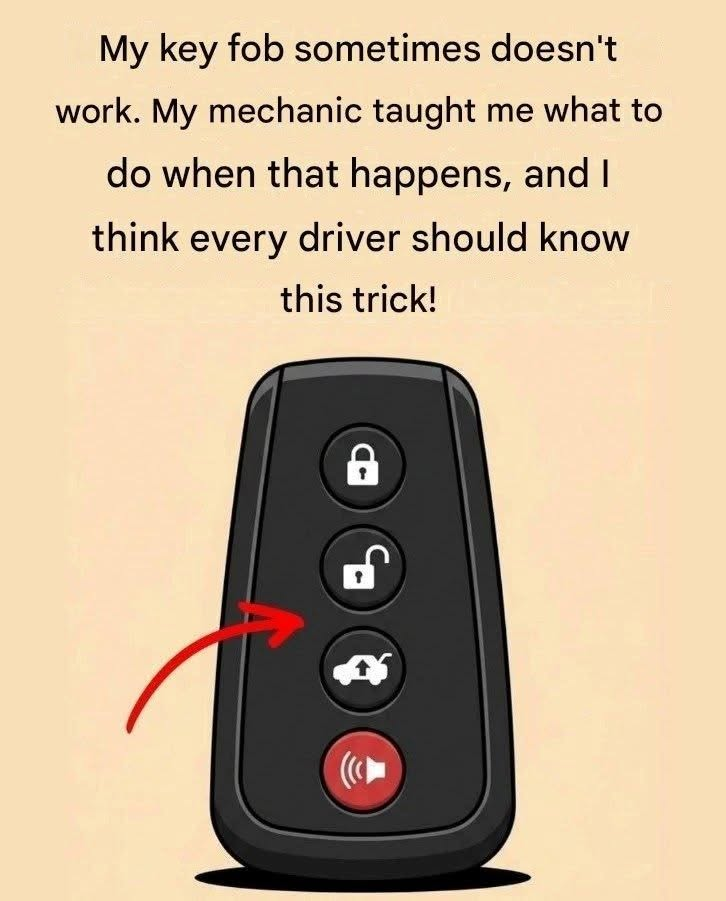
To understand the tricks, it helps to understand the technology. A key fob is essentially a small radio transmitter. When you press a button, it sends a coded signal—typically at a frequency around 315 MHz or 433.92 MHz—to a receiver module in your car . The vehicle’s Body Control Module verifies the code and then executes the command: unlock the doors, pop the trunk, or start the engine.
This system is remarkably reliable, but it has vulnerabilities. The most common failure point is the battery. Most key fobs use a coin-cell battery (often a CR2032 or CR2025) that lasts anywhere from two to five years depending on usage . As the battery weakens, the signal range drops. You might find yourself having to stand closer and closer to the car, or pressing the button multiple times before it responds. Eventually, it stops altogether.
The second major failure point is signal interference. Because key fobs operate on radio frequencies, they can be disrupted by other devices emitting signals on similar frequencies. Wi-Fi routers, Bluetooth devices, signal boosters, and even large LED screens or high-voltage power lines can overwhelm the fob’s relatively weak transmission . This explains why your key might work perfectly at home but fail inexplicably in a specific parking spot. If your fob works sometimes and not others, interference is the likely culprit.
The Body Antenna Trick: Science or Superstition?
One of the most widely shared viral tricks for extending key fob range involves holding the fob directly against your chin or temple while pressing the button. The claim is that your body acts as an antenna, amplifying the signal. Surprisingly, there is genuine physics behind this.
Science educator Kyle Hill demonstrated that the human body, which is composed mostly of water, can act as a dielectric resonator. Your body’s height creates a resonating cavity that can amplify the radio waves emitted by the fob . Holding the fob near your head essentially couples the transmitter to a larger, more efficient antenna—your body. In practical terms, this trick can extend the effective range of your key fob, which is useful when you need to unlock your car from a distance or when signal interference is weakening the transmission. It is not magic, but it is a legitimate physics phenomenon that can work in a pinch .
The Hidden Mechanical Key: Your First Line of Defense
Before worrying about starting the car, you need to get inside. Virtually every modern key fob contains a hidden mechanical key blade. This is the low-tech backup that automakers include for exactly this situation. The key is usually released by pressing a small button or sliding a tab on the side of the fob, allowing you to pull out a traditional metal key .
Once you have the mechanical key in hand, you need to find the keyhole on your driver’s door. On many vehicles, it is hidden behind a small plastic cover on the door handle. You can typically pry this cover off with the key itself or a small tool, revealing the lock cylinder beneath . Turning the key manually will unlock the door.
A word of caution: on some vehicles, using the mechanical key to unlock the door will trigger the alarm. This is normal. The car’s security system interprets the manual unlock as a potential break-in because it did not receive the electronic “all clear” signal from the fob. Once you are inside and the car recognizes the fob (even a dead one) in the ignition or backup reader, the alarm will silence .