My Grandma Has These Hard Bumps Forming on Her Finger Joints Near the Nails. Why Is This Spreading?
A medical evaluation is particularly appropriate if the bumps are new, increasing, painful, or interfering with hand function.
She should seek medical attention promptly if a joint becomes:
Very red or hot
Suddenly and severely painful
Rapidly swollen
Associated with fever
Associated with significant loss of movement
A doctor can examine the fingers and determine whether the changes are consistent with osteoarthritis or another condition.
If the diagnosis is uncertain, an X-ray can sometimes show characteristic joint-space changes or bone spurs. Blood tests may also be used when another type of arthritis needs to be considered.
Can the Bumps Be Removed?
If the bumps are caused by osteoarthritis, there isn’t a treatment that simply reverses the underlying joint changes.
Treatment generally focuses on controlling pain, maintaining movement, and preserving hand function.
Depending on the symptoms, healthcare professionals may recommend measures such as gentle exercises, occupational or physical therapy, heat or cold, or medications for pain. Topical anti-inflammatory medicines may also help some people with painful osteoarthritis.
The appropriate treatment depends on her age, other medical conditions, medications, kidney or stomach problems, and the exact diagnosis.
What Can She Do at Home?
If a doctor confirms hand osteoarthritis, several simple measures may help.
Keep the Fingers Moving
Gentle range-of-motion exercises can help maintain flexibility. Complete inactivity can make stiffness worse.
Exercises should be comfortable rather than forceful. If a particular movement causes significant pain, it should be stopped and discussed with a healthcare professional.
Use Heat for Stiffness
Warm water or another gentle source of heat may help relax stiff hands and make movement more comfortable.
Cold may be useful when a joint becomes irritated or swollen.
Protect Painful Joints
Repeated gripping, pinching, or heavy hand activities can aggravate symptoms. Modifying the way everyday tasks are performed can reduce stress on painful joints.
An occupational therapist can also suggest tools and techniques that make daily activities easier.
Don’t Try to Break or Cut the Bumps
A hard bump around a finger joint should not be punctured, cut, squeezed, or aggressively massaged at home.
If the lump is actually a mucous cyst or another type of lesion, attempting to drain or remove it yourself can cause infection or injury.
The safest approach is to have a healthcare professional identify what the bump actually is before attempting treatment.
The Bottom Line
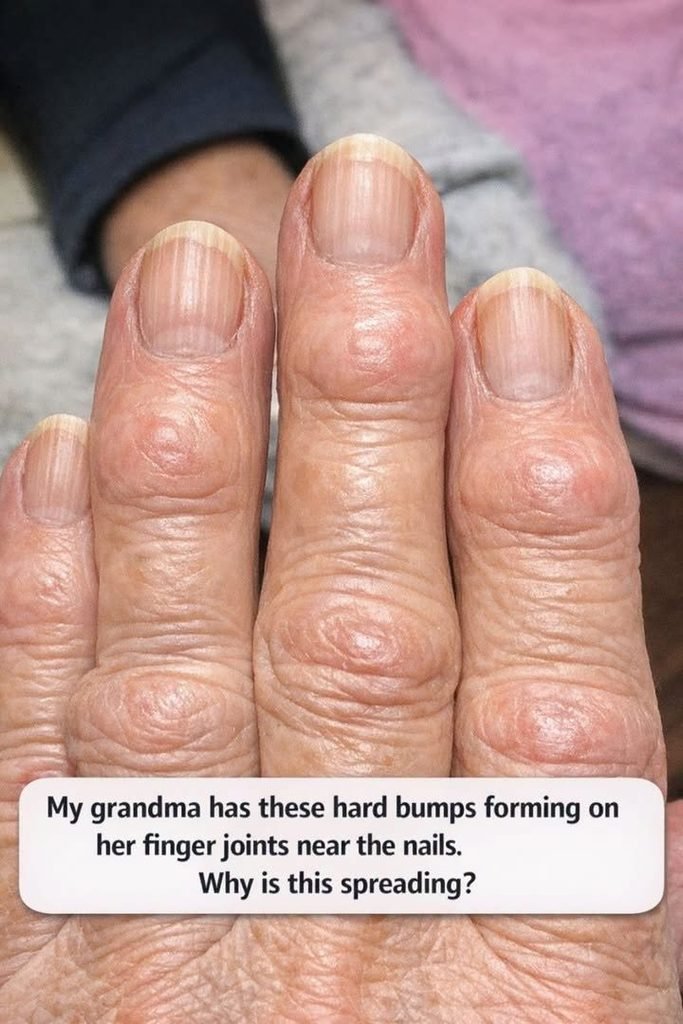
Hard bumps developing around the finger joints closest to the nails are commonly associated with osteoarthritis and may represent Heberden’s nodes, particularly in older adults.
The fact that additional fingers are becoming affected does not necessarily mean the bumps are literally spreading. Osteoarthritis can affect multiple joints over time.
Still, there are other possible causes, including mucous cysts and inflammatory forms of arthritis. A healthcare professional can distinguish between them through examination and, when necessary, imaging or laboratory tests.
If your grandmother’s bumps are new or changing, especially if they are painful, red, swollen, or interfering with her ability to use her hands, arranging a medical evaluation is a sensible next step.