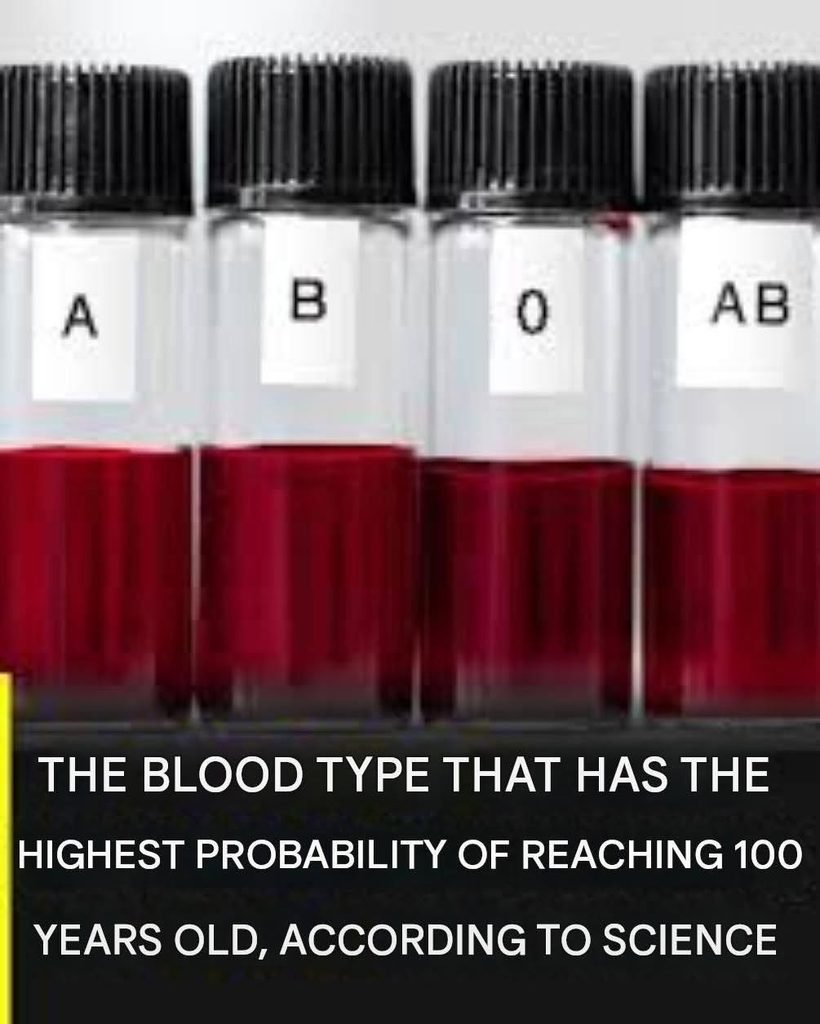
People With This Blood Type Are More Likely to Live to 100 Years Old—What Does the Science Say?
This is where the science becomes particularly interesting.
ABO blood groups have been associated with differences in several biological processes, including blood coagulation and cardiovascular disease risk.
For example, a large UK Biobank analysis involving more than 400,000 people found associations between ABO blood groups and several health outcomes, particularly cardiovascular and thromboembolic conditions.
These differences could theoretically influence long-term health.
But human longevity is extraordinarily complex.
Genes are only one part of the picture.
Lifestyle, environment, socioeconomic conditions, medical care, nutrition, physical activity, smoking, alcohol consumption, infections, chronic diseases, and many other factors can influence survival.
Reaching 100 Is About More Than Genetics
Centenarians are a highly unusual group.
Reaching 100 requires surviving decades of exposure to diseases, injuries, environmental factors, and the normal biological processes associated with aging.
Researchers therefore study centenarians to understand whether particular genetic variants or biological characteristics are disproportionately represented among them.
But having one particular blood type does not guarantee that someone will reach an advanced age.
Likewise, having another blood type does not prevent someone from becoming a centenarian.
The Population Matters
One of the biggest reasons research findings can differ is that populations are different.
The Japanese study involved people living in Tokyo. The larger Chinese study involved a Chinese population. Other research has examined European populations.
Genetic backgrounds, environmental exposures, healthcare systems, lifestyle patterns, and the distribution of blood types can differ between populations.
A finding observed in one group therefore cannot automatically be applied to everyone around the world.
This is an important point whenever a headline turns a population-level statistical association into an individual prediction.
Blood Type Isn’t a Longevity Score
It may be tempting to look at your blood type and ask:
“Does this mean I’ll live longer?”
Current evidence doesn’t support using ABO blood type as a personal longevity score.
Even when researchers observe that one blood group occurs more frequently among centenarians in a particular population, this doesn’t mean that every person with that blood type has a greater chance of reaching 100.
The differences, when observed, may be influenced by multiple interacting biological and environmental factors.
What Actually Matters for Healthy Aging?
Although researchers continue investigating genetics and longevity, there are many established factors that can influence healthy aging.
Maintaining regular physical activity, avoiding tobacco, eating a balanced diet, maintaining a healthy weight, getting adequate sleep, managing chronic conditions, staying socially connected, and receiving appropriate preventive healthcare are all relevant components of long-term health.
Unlike a blood-type label, these are factors people can often influence through everyday choices and medical care.
So, Which Blood Type Is Linked to Living to 100?
There isn’t currently a scientifically established “longevity blood type.”
Blood type B received attention after one Japanese centenarian study found it was more common among people aged 100 and older. But other research has not reproduced that association consistently.
More recent scientific reviews likewise describe the relationship between ABO blood groups and longevity as inconsistent and population-dependent, rather than evidence that one blood type independently determines lifespan.
Final Thoughts
Your blood type is a fascinating biological characteristic, and researchers continue to study how the ABO system relates to cardiovascular disease, blood clotting, cancer, and other health outcomes.
But when it comes to living to 100, the evidence does not support the idea that one blood type guarantees or reliably predicts exceptional longevity.
A viral headline may make it sound as though the secret to reaching 100 is hidden in your blood type.
The scientific picture is much more complicated—and much more interesting.