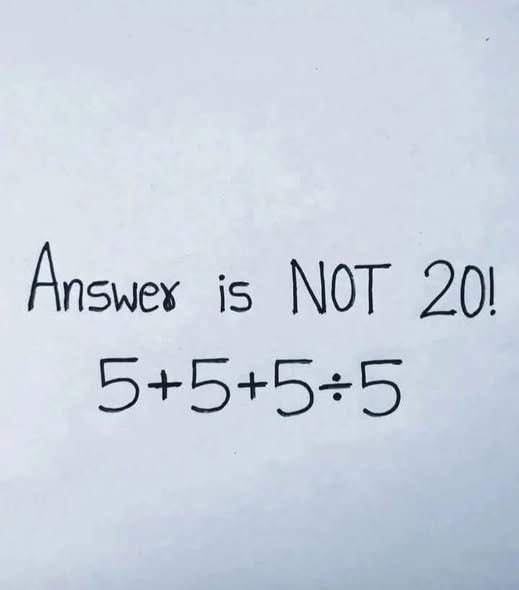
The Answer Is NOT 20! Can You Solve This Simple Math Puzzle?

Why Do So Many People Answer 20?

If you read the equation strictly from left to right, you might think:

5 + 5 + 5 = 15

Then:

15 ÷ 5 = 3

Or, depending on how the expression is mentally grouped, you might simply add the first three numbers and treat the final division separately, producing 20.

But neither interpretation follows the standard mathematical convention for the expression as written.

The division sign has priority over the addition signs.
The Rule to Remember

A useful version of the order of operations is:

Parentheses → Exponents → Multiplication/Division → Addition/Subtraction

When multiplication and division appear together, they are handled from left to right. Addition and subtraction are then handled from left to right.

For this particular puzzle, there are no parentheses or exponents, so the important step is simply:

Division first.

Try This One

Now that you know the trick, consider:

8 + 8 ÷ 8 + 8

Don’t rush.

First:

8 ÷ 8 = 1

Then:

8 + 1 + 8 = 17

So the answer is 17, not 24.

Final Answer

For the puzzle shown in the image:

5 + 5 + 5 ÷ 5 = 11

The lesson is simple: don’t let the order in which numbers appear fool you. Follow the mathematical operation rules first.

Sometimes the easiest-looking puzzles are the ones that make us slow down and think.

Leave a Comment