My Grandma Has These Hard Bumps Forming on Her Finger Joints Near the Nails. Why Is This Spreading?
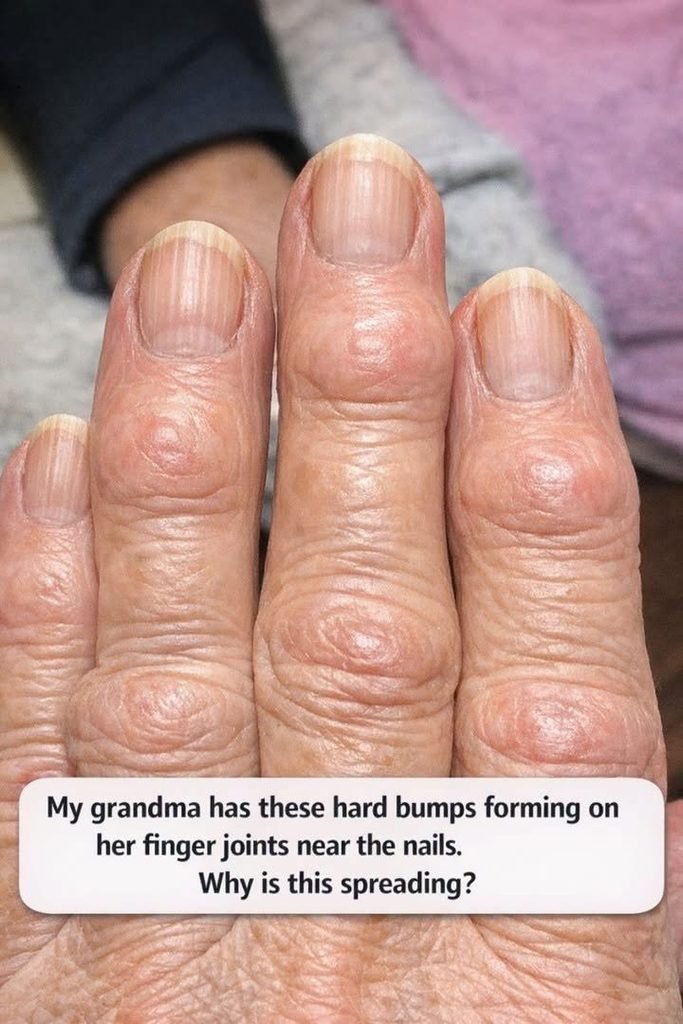
If you have noticed hard, firm bumps developing around your grandmother’s finger joints—particularly the joints closest to her fingernails—it can understandably be concerning when more fingers begin to develop them.
One common explanation is hand osteoarthritis, which can cause bony enlargements known as Heberden’s nodes. These typically develop at the distal interphalangeal joints, the small joints closest to the fingertips.
However, not every bump near a fingernail is arthritis. Cysts and other joint conditions can produce similar-looking lumps, so appearance alone isn’t enough to make a diagnosis.
What Are Heberden’s Nodes?
Heberden’s nodes are firm, bony enlargements that develop around the joints closest to the fingertips.
They are associated with osteoarthritis. As cartilage and other structures within a joint change over time, the surrounding bone can develop new growth called osteophytes, or bone spurs. These can feel like hard lumps beneath or around the joint.
They can occur on one or several fingers and may eventually become noticeable on both hands.
Some people experience significant pain and stiffness, while others have visible bumps with relatively little discomfort.
Why Does It Seem Like the Bumps Are Spreading?
The word “spreading” can be misleading.
The bumps aren’t necessarily spreading from one finger to another like an infection.
Instead, osteoarthritis can affect multiple joints independently. As someone gets older, additional finger joints may develop osteoarthritic changes, making it appear as though the condition is gradually spreading through the hands.
Age is an important risk factor for osteoarthritis, and genetics, previous joint injuries, and repeated stress on joints can also contribute.
What Symptoms Can Occur Along With the Bumps?
Heberden’s nodes may occur alongside several other hand symptoms, including:
Finger stiffness
Joint tenderness
Pain during or after use
Reduced flexibility
Swelling
Grinding, clicking, or cracking sensations
Changes in the shape of the finger joints
Hand osteoarthritis can gradually make everyday activities such as opening jars, gripping objects, or turning keys more difficult.
Importantly, the size of a bump doesn’t necessarily tell you how painful the arthritis will be.
Could It Be Something Other Than Arthritis?
Yes.
A digital mucous cyst, for example, is a type of ganglion cyst that can develop near the fingernail. These cysts may appear as small lumps close to the end joint of a finger and can sometimes make the nearby skin thin or allow fluid to leak if they rupture. They are also associated with osteoarthritis of the nearby joint.
Other forms of arthritis—including rheumatoid arthritis, psoriatic arthritis, and gout—can also affect the hands, although they typically have different patterns and symptoms.
This is why a healthcare professional should examine persistent or changing finger lumps rather than assuming they are simply age-related bumps.