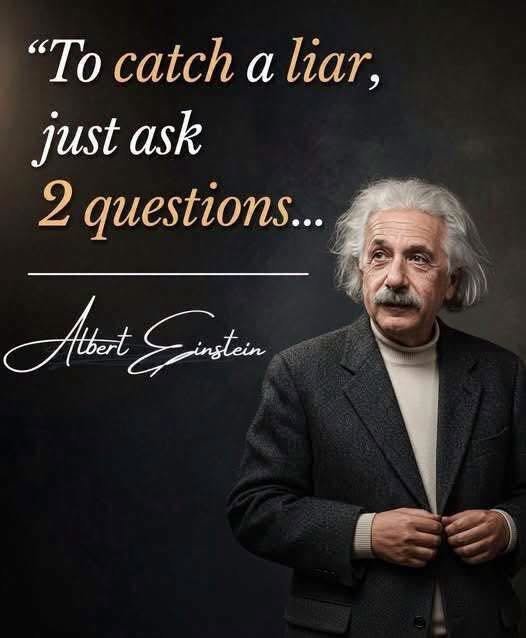
🧠 “To Catch a Liar, Just Ask 2 Questions” – The Truth Behind This Viral Einstein Quote
You may have seen a quote circulating online that claims:
“To catch a liar, just ask two questions.”
The statement is often presented as a piece of wisdom from Albert Einstein, suggesting that the famous physicist discovered a simple psychological trick for exposing dishonesty.
It sounds convincing.
It is also much less certain than the internet makes it appear.
There is no reliable historical evidence establishing that Einstein actually said this phrase. Recent searches for the quotation and its supposed attribution have not produced a documented source in Einstein’s published work, correspondence, or recorded speeches.
So where did the idea come from—and can two questions really expose a liar?
The Einstein Attribution Is the First Problem
Albert Einstein has become one of the most frequently quoted figures on the internet.
Numerous sayings about intelligence, imagination, truth, success, relationships, and human behavior are attributed to him despite lacking a verifiable primary source.
The “two questions” statement appears to belong to this broader phenomenon.
Online versions vary in their wording, with some saying:
“To catch a liar, just ask two questions.”
Others describe the technique as a way to “unmask” a liar or claim that asking for additional details will immediately reveal deception.
But the existence of a popular quotation online doesn’t establish that Einstein actually said it.
So, Can Two Questions Catch a Liar?
Not reliably.
There is no universal pair of questions that can determine whether someone is telling the truth.
A person’s nervousness, hesitation, eye contact, confidence, or changes in speaking style can have many explanations. Someone telling the truth may appear anxious, while someone who is lying may appear completely relaxed.
Even inconsistencies aren’t automatically proof of deception.
People forget details. Memories change. Stress can affect recall. Two people can honestly remember the same event differently.
That’s why a single conversational trick shouldn’t be treated as a human lie detector.
Why Asking for Details Can Still Be Useful
Although there is no magical two-question formula, asking someone to explain an event in greater detail can provide more information.
For example, instead of immediately accusing someone of lying, you might ask:
“Can you walk me through exactly what happened?”
Then follow up with:
“What happened immediately before and after that?”
These questions don’t prove dishonesty.
Their value is that they encourage a fuller account that can potentially be compared with other available information.
If a story contains contradictions, the appropriate response is to investigate those contradictions rather than automatically declaring the person a liar.
Why Detailed Questions Can Change a Conversation
When someone describes a genuine experience, they may be able to provide additional contextual information because they actually experienced the event.
But memory is imperfect, so genuine people can also struggle with specific details.
A person who is deliberately fabricating a story may face a different challenge: maintaining consistency across multiple details.
That distinction is important.
A contradiction can be a reason to ask another question. It is not necessarily proof that someone deliberately lied.