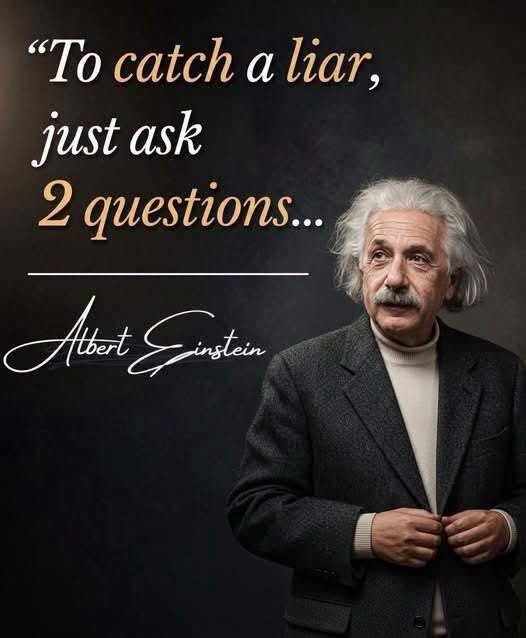
🧠 “To Catch a Liar, Just Ask 2 Questions” – The Truth Behind This Viral Einstein Quote
One of the biggest problems with viral deception advice is the idea that certain physical behaviors automatically reveal dishonesty.
For example, internet posts sometimes claim that looking away, touching your face, crossing your arms, avoiding eye contact, or fidgeting proves that someone is lying.
Human behavior is far too complicated for such simple rules.
Someone might avoid eye contact because they are shy. Another person might maintain strong eye contact because they are trying to appear confident.
Body language can provide context, but it should not be treated as definitive evidence of deception.
Evidence Matters More Than a “Gotcha” Question
If the truth really matters, independent evidence is generally more useful than trying to psychologically trap someone.
Depending on the situation, relevant evidence might include:
Messages or emails
Dates and timestamps
Documents
Photographs or recordings
Independent witnesses
Physical evidence
Records that can be independently verified
The more consequential the situation, the more important it becomes to distinguish suspicion from evidence.
Why the Einstein Name Makes the Quote More Powerful
There is a psychological reason these quotes spread so easily.
Research on quotation attribution has found that people can respond differently to the same quotation depending on whether it is presented as coming from a famous person or an unknown source. In other words, attaching a prestigious name can influence how people perceive a statement.
That helps explain why a simple piece of modern advice can become much more compelling when it is presented as an Einstein insight.
The name adds authority—even when the attribution itself has not been demonstrated.
What Einstein Actually Did Say
There are, of course, many well-documented writings and statements from Einstein.
His correspondence and scientific publications survive in extensive historical collections. For example, authenticated Einstein correspondence includes letters discussing physics, philosophy, and scientific questions with contemporaries such as Michele Besso.
That makes the absence of a credible primary source for the “two questions” quotation especially important.
A quotation attributed to a historical figure should ideally be traceable to a letter, book, speech, interview, transcript, or other reliable contemporary record.
The Better Lesson Behind the Viral Quote
Even though the Einstein attribution is unsupported, there is a useful idea hidden underneath the viral claim:
Good questions can reveal more information.
Instead of trying to “catch” someone, ask them to explain what happened.
Ask for chronology.
Ask for relevant details.
Compare the account with independently available information.
And if something doesn’t make sense, investigate the specific inconsistency rather than jumping immediately to a conclusion.
That approach is much more reliable than searching for a magical question that supposedly exposes every liar.
Two Questions You Can Actually Ask
If you need clarification about someone’s account, two practical questions are:
1. “Can you explain exactly what happened, step by step?”
This encourages a chronological account rather than a simple yes-or-no response.
2. “What happened immediately before and immediately afterward?”
This adds surrounding context and may help clarify details that initially seemed incomplete.
Again, neither question is a lie detector.
Their purpose is simply to gather better information.
Final Thoughts
The viral claim that “to catch a liar, just ask two questions” makes deception detection sound far easier than it really is.
More importantly, the popular attribution to Albert Einstein does not appear to be supported by reliable historical evidence.
There is no magic phrase that can instantly reveal whether someone is lying.
The more useful approach is to ask clear questions, listen carefully, look for meaningful inconsistencies, and—when the stakes are high—look for independent evidence.
So the next time you see an inspirational quote carrying Einstein’s name, pause before sharing it.
Sometimes the real question isn’t “Is this person lying?”
It’s “Where is the evidence that Einstein actually said it?”