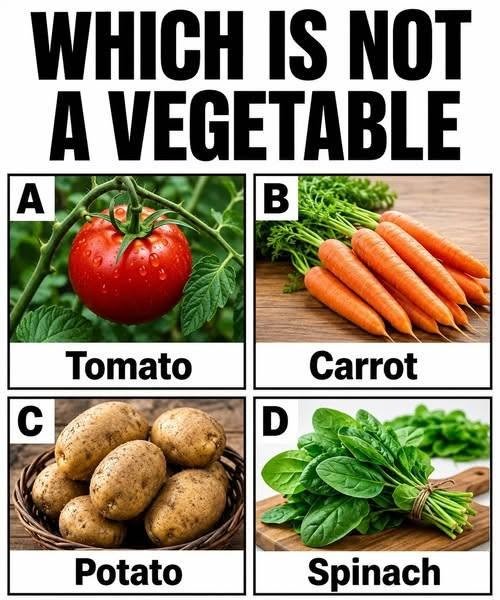
Which Is Not a Vegetable? The Surprising Truth About Tomatoes
Unlike fruit, the term “vegetable” does not have one single, universally equivalent botanical definition.
In everyday nutrition and cooking, vegetables generally refer to edible plant parts other than fruits, particularly leaves, stems, roots, bulbs, and sometimes immature plant structures.
For example:
Carrots are roots.
Celery is primarily a stem.
Spinach is a leafy vegetable.
Onions are bulbs.
Broccoli consists largely of immature flower structures.
These foods are grouped together as vegetables in culinary and nutritional contexts even though their plant structures differ considerably.
The Famous Tomato Classification Debate
Tomatoes have even been involved in a famous historical legal dispute in the United States.
In the late nineteenth century, the U.S. Supreme Court considered whether tomatoes should be treated as fruits or vegetables for the purposes of an import tariff.
The Court ultimately treated tomatoes as vegetables in that legal context because they were commonly served with meals rather than as dessert.
Importantly, the decision did not overturn the botanical classification of tomatoes as fruits. It addressed a specific legal and commercial question.
This episode is one reason the tomato’s fruit-versus-vegetable debate remains so well known.
Does the Classification Matter for Nutrition?
Usually, not very much.
Whether you call a tomato a fruit or vegetable does not change its nutritional composition.
Tomatoes provide nutrients and plant compounds including vitamin C, potassium, folate, and carotenoids such as lycopene.
They can be part of a balanced diet whether they appear in a salad, sauce, soup, sandwich, or another dish.
From a nutrition perspective, the more useful question is often not “Is this technically a fruit?” but rather “How does this food fit into my overall eating pattern?”
Raw Tomatoes vs. Cooked Tomatoes
Another interesting feature of tomatoes is that preparation can change their nutritional characteristics.
Tomatoes can be eaten raw in salads and sandwiches, or cooked into sauces, soups, stews, and other dishes.
Cooking can alter the structure of plant tissues and affect the availability of certain compounds. At the same time, cooking methods and added ingredients can change the overall nutritional profile of a dish.
This is one reason there is no need to think of tomatoes as having only one “correct” way to eat them.
Variety in preparation can make it easier to enjoy them regularly.
Why This Distinction Is So Interesting
The tomato demonstrates how classification depends on context.
A botanist may look at the plant’s reproductive structure and identify a fruit.
A chef may look at the same tomato and immediately think about sauces, salads, savory dishes, and seasonings.
A nutrition professional may focus on its nutrients and how it contributes to a balanced eating pattern.
A lawyer or customs official may use yet another definition for a specific legal purpose.
None of these perspectives necessarily cancels out the others.
So, Is a Tomato a Fruit or a Vegetable?
The simplest answer is:
A tomato is botanically a fruit and commonly treated as a vegetable in cooking.
More specifically, botanically it is a type of berry.
That distinction explains why the tomato can simultaneously belong to the world of fruits scientifically and the world of vegetables on the dinner table.