How Caramelized Should Your Onions Be? A Guide to Perfectly Sweet Onions
Caramelized onions are one of the simplest ways to add remarkable depth and sweetness to a dish. With nothing more than onions, fat, heat, and time, ordinary slices can transform into soft, glossy, deeply golden strands with a rich, almost jam-like flavor.
But there is one question that often causes confusion: How caramelized should onions actually be?
The answer depends on what you are cooking. Some dishes benefit from lightly golden onions with a mild sweetness, while others call for onions that have been cooked until deeply brown, intensely flavorful, and almost spreadable.
Understanding the different stages of caramelization makes it much easier to get the result you want.
What Happens When Onions Caramelize?
Onions contain natural sugars as well as water. When they are heated, the water gradually evaporates and the onions soften. As cooking continues, chemical reactions create the characteristic brown color and complex flavors associated with caramelized onions.
True caramelization involves the breakdown of sugars under heat. Other browning reactions, particularly the Maillard reaction, can also contribute to the flavor and color that develop during cooking.
The important point for home cooks is that browning takes time.
Simply cooking onions until they are translucent is not the same as caramelizing them.
The Different Stages of Caramelized Onions
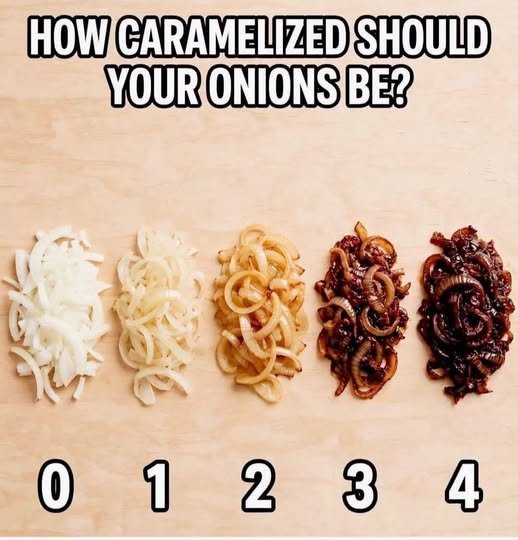
There is no single “correct” shade of caramelized onion. Instead, think of caramelization as a spectrum.
1. Soft and Translucent
At the earliest stage, onions become soft, glossy, and translucent.
They may take roughly 5–10 minutes, depending on the quantity, pan, and heat.
At this point, they have lost their raw sharpness but have developed relatively little deep sweetness.
This stage is ideal when onions are being used as part of the foundation for soups, sauces, stews, and many savory dishes.
2. Light Golden
After more cooking, the onions begin developing a pale golden color.
They are softer and noticeably sweeter, but they still retain some structure.
This stage works well for burgers, sandwiches, omelets, pasta dishes, and other recipes where you want sweetness without an extremely intense caramelized flavor.
3. Deep Golden Brown
This is where the classic caramelized-onion character really begins to emerge.
The onions become deeply golden, glossy, soft, and concentrated. Their flavor is significantly sweeter and more complex than at the earlier stages.
Depending on the heat, pan, quantity, and desired result, this can take approximately 30–60 minutes.
For many cooks, this is the sweet spot for a classic batch of caramelized onions.
4. Deep Brown and Jammy
At the final stage, the onions become very dark brown, extremely soft, and almost jam-like.
Their volume will have reduced dramatically because much of their original water has evaporated.
The flavor becomes intensely sweet, savory, and concentrated.
This stage is excellent for dishes where caramelized onions are intended to be a major component, such as onion tart, French onion soup, sandwiches, steak toppings, or spreads.
However, there is an important distinction: deep brown is desirable; black is usually burnt.
What Color Should Perfect Caramelized Onions Be?
For a classic batch, aim for a deep golden to rich brown color.
The onions should look glossy and soft, with no large areas of blackened or charred onion.
A few darker pieces are not necessarily a problem, but widespread blackening usually indicates excessive heat.
The goal is gradual browning rather than aggressive frying.
If the onions are pale after a long cooking time, they simply need more time. If they are becoming dark very quickly, the heat is probably too high.
Why Low and Slow Works
One of the biggest mistakes people make is turning up the heat because they want caramelized onions quickly.
High heat can certainly brown onions, but it also increases the risk of burning them before their interior has had time to soften and develop sweetness.
A moderate or moderately low heat allows the onions to lose moisture gradually while their flavor becomes increasingly concentrated.
The process can take patience, but the texture and flavor are usually worth it.
How to Caramelize Onions Properly
Start by slicing the onions relatively evenly. Thin slices will cook more quickly, while thicker slices retain more structure.
Heat a wide, heavy-bottomed skillet over moderate heat and add butter, oil, or a combination of the two.
Add the onions and a small amount of salt.
The onions will initially fill the pan. As they cook, they release water and shrink considerably.
Stir periodically, especially as the onions become darker.
If brown residue begins forming on the bottom of the pan, add a small splash of water and scrape it up with a wooden spoon. Those browned bits contain concentrated flavor and can be incorporated back into the onions.
Continue cooking until the onions reach the color and texture you want.